

What Is Grade 5 Hardware and Why Does It Matter for Overhead Storage?
Grade 5 hardware is a medium-carbon steel bolt and fastener grade under the SAE J429 standard, heat treated for a minimum tensile strength of 120,000 psi (827 MPa) in sizes from 1/4 to 1 in (6 to 25 mm). It matters for overhead storage because the fasteners carry the entire load hanging over your car and anyone walking below.
What does "Grade 5" actually mean?
Grade 5 is a strength rating for inch-sized steel bolts and screws, defined by the SAE J429 standard. It tells you the fastener's material, how it was heat treated, and the minimum strength it must reach.
Grade 5 bolts are made from medium-carbon steel that is quenched and tempered. In sizes from 1/4 in to 1 in (6 to 25 mm) in diameter, they must reach a minimum tensile strength of 120,000 psi (827 MPa) and a proof load of 85,000 psi (586 MPa). Proof load is the stress a bolt must hold without permanently stretching.
The grade is a minimum, not a guess. A bolt that is properly made and marked as Grade 5 has to meet those numbers.
How does Grade 5 compare with Grade 2 and Grade 8?
Grade 5 sits in the middle of the three SAE J429 grades covered here. It is much stronger than general-purpose Grade 2 and less brittle than the very hard Grade 8.
| Grade | Material | Minimum tensile strength (1/4 to 3/4 in, 6 to 19 mm) | Head marking | Typical use |
|---|---|---|---|---|
| Grade 2 | Low or medium carbon steel | 74,000 psi (510 MPa) | No radial lines | Light-duty, general household |
| Grade 5 | Medium carbon steel, quenched and tempered | 120,000 psi (827 MPa) | 3 radial lines | Automotive, equipment, structural brackets |
| Grade 8 | Medium carbon alloy steel, quenched and tempered | 150,000 psi (1,034 MPa) | 6 radial lines | High-stress machinery, suspension parts |
If you work with metric hardware, property class 8.8 is the rough counterpart to Grade 5, and class 10.9 is the rough counterpart to Grade 8.
Why does fastener grade matter for overhead garage storage?
An overhead rack or lift is only as strong as the parts holding it together. The steel platform can be well built, but if the bolts connecting the frame, brackets, and hangers stretch or shear, the load comes down.
Overhead storage puts fasteners through conditions that a shelf on the floor never sees:
- Constant tension. Hanging loads pull on bolts all day, every day, not only when you add a tote.
- Shifting loads. Sliding a tote across the deck or raising and lowering a lift moves the stress around the frame.
- Temperature swings. Garages heat up and cool down, which works joints over time.
- Something below. A failure lands on a car, a workbench, or a person, so a margin of strength is worth having.
Graded hardware gives you a known minimum strength at every connection instead of an unknown one.
Is a higher grade always better?
No. Higher grade means higher strength, but also harder steel that tolerates less bending before it breaks. For overhead storage connections, Grade 5 balances strength with some ability to flex.
The bigger rule is to use exactly what the manufacturer specifies. Swapping in a different bolt, even a "stronger" one, changes how the joint behaves. Never replace a supplied fastener with an unmarked bolt from a mixed bin.
How can you tell if a bolt is Grade 5?
Look at the head. A Grade 5 hex bolt has three evenly spaced radial lines raised or stamped on top, and usually a manufacturer's mark as well.
- Three radial lines: Grade 5.
- Six radial lines: Grade 8.
- No lines: Grade 2 or ungraded.
- Numbers such as 8.8 or 10.9: metric property class.
Stainless steel fasteners use a different rating system and are not marked with SAE grade lines, so do not assume a stainless bolt matches Grade 5 strength.
What else matters besides bolt grade?
Hardware grade is one link in the chain. A safe overhead system also depends on these:
- Solid framing. Every system must be fastened into joists or trusses, never into drywall alone. If you are unsure what is above your ceiling or how much it can carry, have your framing checked by a contractor.
- Correct installation. Use every fastener the instructions call for, at the locations shown, and tighten as directed.
- A published weight rating. Load within the rating and spread the weight evenly. Do not pile the heaviest items in one corner.
- Clearance. Keep the system clear of garage door tracks, the opener, lights, and the roof of your tallest vehicle.
- Periodic checks. Look over the frame and connections from time to time and tighten anything that has loosened.
What hardware does CeilingSAM use?
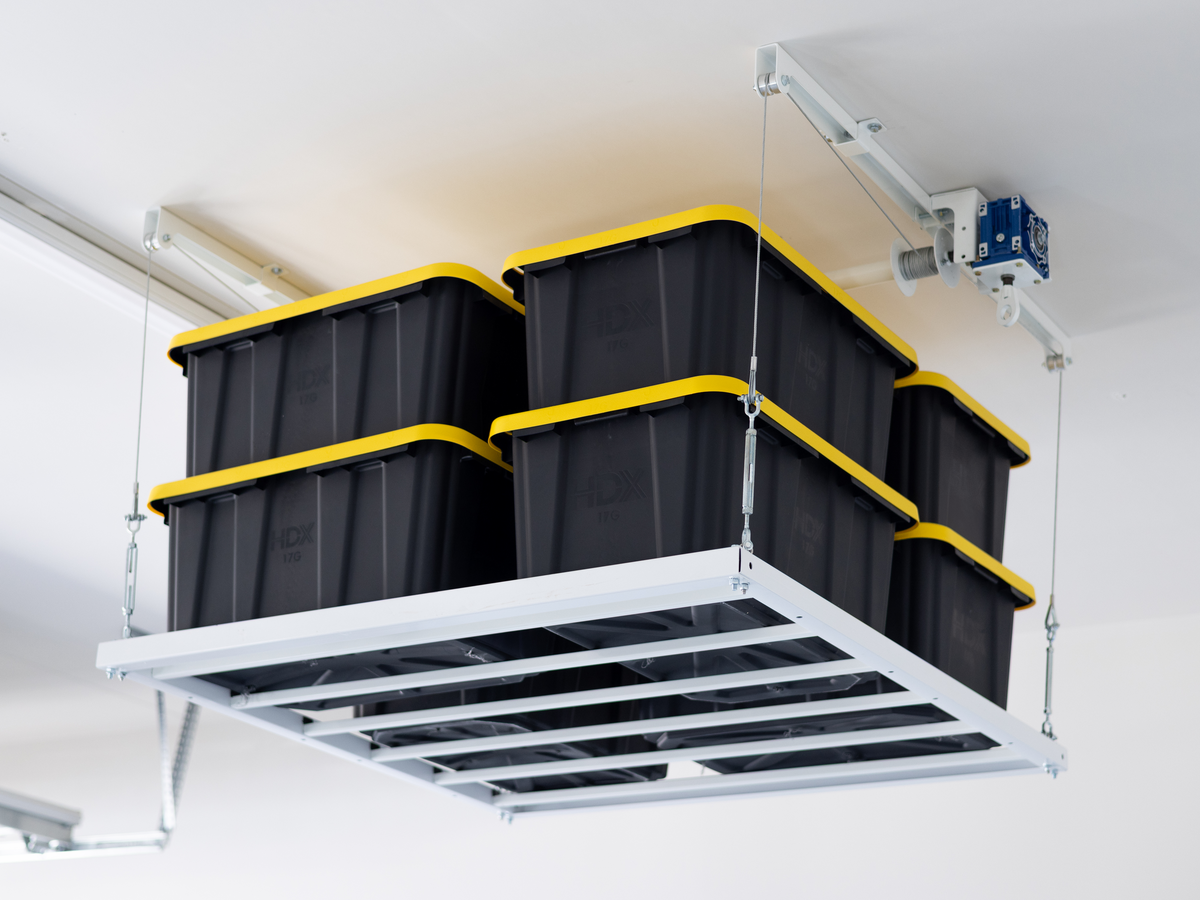
CeilingSAM systems are made in Oregon, USA, with Grade 5 hardware, and they are backed by a Limited Lifetime Warranty. That includes fixed racks such as the Heavy-Duty Pro ceiling racks and the drill-powered Storage Elevators.
As an example of rated capacity, the 4'X4' (1.2 x 1.2 m), 4'X6' (1.2 x 1.8 m), and 4'X8' (1.2 x 2.4 m) Storage Elevators are each rated for 400 lb (181 kg) evenly distributed, and the 4'X8' Storage Elevator PRO is rated for 700 lb (318 kg) evenly distributed. As of October 2026, Storage Elevators start at $999 for the 4'X4' and the Heavy-Duty Pro starts at $499 for the 4'X4'.
A CeilingSAM system may not be the right fit if you rent and cannot fasten into the ceiling, or if you only need to store a few light items, where a wall shelf or freestanding shelving may be enough. You can review the full coverage on the Limited Lifetime Warranty page, and the installation guides show which hardware goes where. If you would rather not install it yourself, CeilingSAM can connect you with top-rated independent installers in your area through Find My Installer.
Frequently asked questions
Is Grade 5 hardware strong enough for garage ceiling storage?
Grade 5 is specified for automotive and equipment connections that see real loads, which makes it a sound choice for overhead storage. What matters just as much is that the system is installed into solid framing and loaded within its published rating.
Can I replace a missing bolt with one from the hardware store?
Match the size, length, thread, and grade exactly, and check the head markings before you install it. When in doubt, contact the manufacturer for a replacement so the connection matches the original design.
Does galvanized or zinc-plated hardware change the grade?
Plating is a coating for corrosion resistance. The grade comes from the steel and its heat treatment, so check the head markings rather than the finish.
Are lag screws into the joists also Grade 5?
Lag screws are not always rated on the same SAE scale as bolts, so the head may not carry grade lines. Use the lag screws or structural fasteners supplied with your system, at the size and length the instructions specify.
How often should I check the hardware on my overhead rack?
A quick look a few times a year, and after any bump from a vehicle or ladder, is good practice. Tighten anything loose and stop using the system if you see bent parts or damaged connections.
CeilingSAM comes from the family that pioneered overhead garage storage in 1998. Every system is made in Oregon, USA, with Grade 5 hardware and is backed by our Limited Lifetime Warranty. Storage Elevators are drill-powered, never motorized. Questions about your garage? Call or text (480) 720-0593.
Questions about your garage? Real people, fast answers.
Call or text(480) 720-0593