


Storage Lifts for Garage: How Ceiling Lifts and Hoists Work and How to Pick the Right One
Overhead storage has become one of the most popular garage organization upgrades for good reason: it takes all the bulky, awkward, seasonally-used stuff that's cluttering your floor and moves it to the one part of the garage that almost no one ever uses — the ceiling.
Fixed ceiling racks handle a lot of that job well. But they come with one obvious limitation: once something is stored up high, you need a ladder to get it back down. For bins of holiday decorations or camping gear you touch twice a year, that's a manageable trade-off. For anything you access more regularly, it's a real inconvenience.
That's where a storage lift for the garage changes the equation. A garage lifting system lets you lower your overhead storage platform down to a workable height, load or unload it, then raise it back to the ceiling — no ladder required. It sounds like a luxury, but for active households that actually use their stored gear, it's one of the most practical upgrades you can make.
This guide covers how garage storage lifts work, the different types available, what to look for when choosing one, and how they fit into a complete garage organization system.
How a Garage Storage Lift System Works
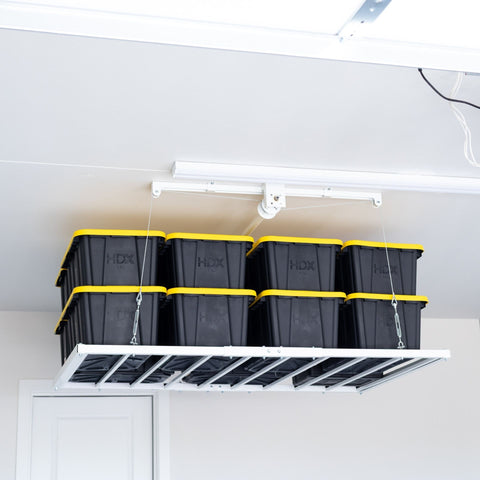
The core concept is straightforward. A storage platform — typically a steel rack or frame — is suspended from the ceiling by cables, straps, or a motorized mechanism. When you want to access stored items, you engage the lift system to lower the platform down to a convenient height. When you're done, you raise it back up, where it sits flush against (or close to) the ceiling out of the way.
The mechanism that does the raising and lowering is what separates different types of garage storage lift systems from each other. There are three main approaches:
Manual / Pulley-Based Lifts
A manual garage storage lift uses a rope, strap, or cable routed through a pulley system anchored to the ceiling joists. You pull on the free end of the rope to raise the platform and secure it in position with a locking cleat or ratchet. To lower it, you release the lock and guide it down under control.
These systems are mechanically simple, relatively affordable, and have no electrical components to maintain or fail. The trade-off is that they require physical effort proportional to the weight on the platform — a fully loaded rack with 200+ lbs of gear takes meaningful effort to raise and lower, and they're best suited for lighter loads or less frequent use.
Drill-Powered / Hand-Crank Lifts
Drill-powered storage lifts use a standard cordless drill to drive the lift mechanism. You attach your drill to the drive point and the gear system does the heavy work, raising or lowering the platform smoothly with far less physical effort than a manual pulley. This approach gives you the mechanical advantage of a powered system without requiring permanent electrical wiring.
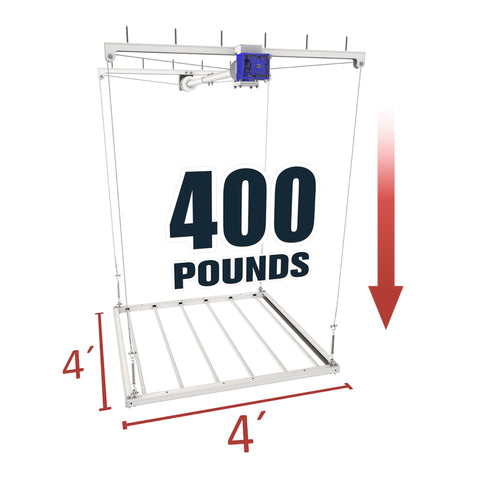
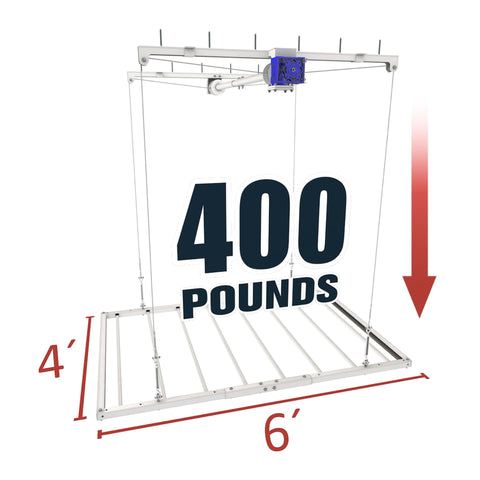
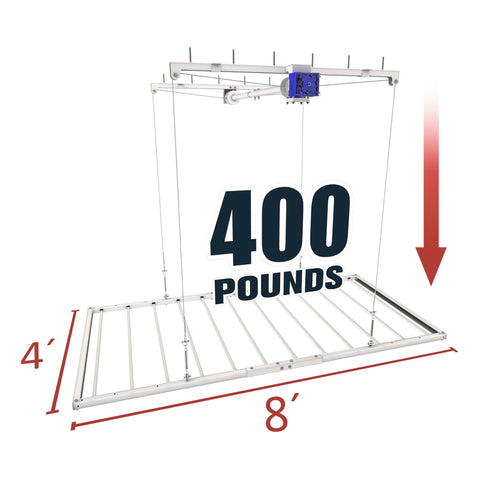
Ceiling SAM's retractable storage lift lineup uses this drill-powered approach. The 4x4 Retractable Overhead Garage Storage Rack, 4x6 Retractable Garage Storage Lift, and 4x8 Retractable Garage Storage Lift all drop up to 8 feet and hold 400 lbs of distributed weight, making them capable of handling everything from holiday tubs to camping gear to sports equipment. The drill-powered design means no electrical installation, no motor to maintain, and no wall switch to wire in — just connect your drill and go.
Motorized / Electric Lifts
A fully motorized garage storage lift motor automates the raising and lowering process entirely. You press a button — on a wall switch or a remote — and the system does the work. This is the most convenient option by a significant margin, especially for heavier loads or users who need to access overhead storage frequently.
For homeowners who want the ultimate in convenience, Ceiling SAM's 4x8 Storage Elevator Pro offers a fully motorized lifting system with 700 lb capacity, accommodating ceilings from 8 to 14 feet with an 8- or 11-foot drop. It's the flagship option for serious garage storage — the kind of system that makes your overhead storage as easy to use as a regular shelf, just one that happens to live near the ceiling when you don't need it.
Storage Lifts vs. Fixed Ceiling Racks: When Does a Lift System Make Sense?
A garage storage lift system costs more than a fixed ceiling rack of the same size. So the key question is whether that added cost is worth it for your situation. Here's how to think through it.
A fixed ceiling rack is likely the right choice if:
You're storing items you access only 1-2 times a year — holiday decorations, off-season sports gear, tax documents, camping equipment for rare trips
Budget is a primary concern and you're comfortable using a ladder when needed
Your ceiling height means the stored items would be comfortably reachable from a step stool without feeling dangerous
You want maximum weight capacity per dollar spent
Ceiling SAM's fixed racks — the 4x4, 4x6, and 4x8 Heavy-Duty Ceiling Storage Racks — are purpose-built for exactly this use case, with capacities up to 1,000 lbs and a robust steel build designed to last.
A garage storage lift system is likely the right choice if:
You access stored items monthly or more frequently — sports equipment, tools, seasonal gear you rotate regularly
Your ceiling is 9 feet or higher, making a ladder feel less safe or less practical for routine access
Anyone in your household has physical limitations that make ladder use inconvenient or unsafe
You want to encourage everyone in the household — including kids — to actually use and return items from overhead storage
You're storing heavier loads that would be risky to manage on a ladder
Overhead Garage Storage Lift: Key Specs to Understand
When shopping for a garage storage ceiling lift, a few specifications will determine whether a system actually fits your garage and your needs.
Weight Capacity
Every garage storage lift rack has a rated weight capacity, typically expressed as a total distributed load. "Distributed" is the key word — this means weight spread across the full platform, not concentrated in one corner. A 400 lb capacity platform can handle a lot of tubs and gear when loaded evenly; the same platform loaded with 400 lbs in one spot is a different (and potentially unsafe) situation.
Be realistic about what you'll actually store. Seasonal tubs, camping gear, and sports equipment add up faster than most people expect. Weigh your intended load if possible, and choose a system with meaningful capacity headroom above your actual needs.
Drop Distance and Ceiling Height
A garage storage lift motor or lift system is only useful if it can actually lower the platform to a height where you can comfortably reach it. Standard systems offer 8-foot drop distances, which is appropriate for garages with 9-10 foot ceilings — the platform stores near the ceiling and lowers to about waist-to-chest height for loading.
For garages with higher ceilings — 10, 12, or 14 feet — you need a system with a longer drop capacity or an adjustable drop. Check the manufacturer's specifications carefully against your actual ceiling height before purchasing. A system that only drops 8 feet in a 12-foot ceiling still leaves the platform 4 feet off the floor when fully lowered, which isn't useful.
Platform Size
Lift systems for garage storage are most commonly available in 4x4, 4x6, and 4x8 foot platform sizes. The right size depends on how much you need to store and how much ceiling real estate you have available.
4x4: Good for a focused storage zone — above a workbench, in a single-car bay, or in a corner where ceiling space is limited. Holds a moderate number of tubs or one large item like a kayak or rooftop carrier.
4x6: A solid middle-ground size for most two-car garages. Enough space for a full season's worth of gear without dominating the ceiling.
4x8: The high-capacity option for serious storage needs. Works well spanning the width of a standard garage bay and can hold a substantial number of bins and larger items side by side.
Ceiling Height Requirements
Every lift system has a minimum ceiling height requirement — this is the height at which the system can be safely installed and still provide useful clearance when lowered. Always confirm your actual ceiling height (measure it, don't estimate) and check it against the product's specifications before ordering.
Garage Hoist Storage vs. Garage Storage Lift: Is There a Difference?
The terms get used interchangeably, but there is a subtle distinction worth understanding.
A garage hoist traditionally refers to a single-point lifting mechanism — typically designed to raise and lower a single heavy item like a motorcycle, ATV, canoe, or engine. A hoist for garage storage is usually attached to a single hook or sling and operates via a hand crank, electric winch, or pulley. It's purpose-built for lifting one specific heavy item, not for platform-style storage of multiple bins and boxes.
A garage storage lift system, by contrast, refers to a multi-point platform lift — a full rack or frame that raises and lowers as a unit. This is the right category for organized overhead bin and box storage, where you want a stable, level surface to hold multiple containers rather than a single sling point.
Both have their place. If you need to store a kayak, motorcycle, or heavy seasonal equipment as a single large item, a dedicated hoist may be appropriate. If you're organizing seasonal bins, camping gear, sports equipment, and similar items across a storage platform, a garage storage lift rack is the better tool.
Lift System for Garage Storage: Installation Basics
Garage storage lifts are more involved to install than simple fixed ceiling racks, but they're still within reach of a capable DIYer. Here's what to expect.
Ceiling Structure Requirements
All overhead garage storage lifts must be anchored to structural ceiling framing — joists or trusses — not to drywall or a finished ceiling surface alone. Before purchasing, verify that your ceiling joists are accessible (either exposed or reachable through drywall) and that they're spaced compatibly with the lift system's mounting hardware.
Engineered trusses — the triangulated framing common in homes built after the 1980s — require a different anchoring approach than traditional dimensional lumber joists. If you have truss framing, check the manufacturer's installation guidance before assuming standard hardware will work.
Alignment and Levelness
A platform that isn't level will cause stored items to shift, bins to slide, and uneven load stress on the lift mechanism. Take time during installation to get the platform level — both side-to-side and front-to-back. Most systems include adjustment provisions for this; use them.
Clearance from Garage Door Hardware
The single most common installation conflict is with garage door tracks and the opener rail. The door track runs along the ceiling toward the back of the garage, and the opener motor hangs from the center. Plan your lift placement around these obstructions — measure their positions carefully before marking mounting points.
Professional Installation Option
For homeowners who'd rather not tackle the installation themselves, Ceiling SAM has a network of professional installers who can handle setup correctly and efficiently. If you're dealing with a high ceiling, a heavy-capacity system, or any uncertainty about your ceiling structure, professional installation is a worthwhile investment in both safety and peace of mind.
Making the Most of Your Garage Storage Lift: Organization Tips
A garage storage ceiling lift is only as useful as the organization system on it. Here's how to get the most out of it once it's installed.
Use consistent-size totes. Uniform bins stack and organize more cleanly on a lift platform than a mix of random boxes and bags. Standard 27-gallon totes are a popular choice — widely available and sized to fit well on most 4-foot-wide platforms.
Label everything on two sides. When the platform comes down, you want to identify bins at a glance without rotating them. Labels on two adjacent sides means one is always visible regardless of orientation.
Distribute weight evenly. Load heavier items toward the center and balance weight left-to-right. Uneven loading stresses the lift mechanism and causes the platform to hang unevenly.
Group by access frequency. Items you retrieve a few times a year go to the back or center of the platform; things you grab more often go toward the edges where they're easiest to reach when the platform is lowered.
Don't exceed the weight rating. This bears repeating. Rated capacity is a maximum, not a guideline. Know what's on the platform and keep it well under the limit.
Pairing a Garage Lift with Other Storage Solutions
A storage lift for the garage works best as part of a complete overhead organization strategy rather than a standalone solution. Most garages benefit from a combination of storage types working together.
For example: a retractable garage storage lift handles the gear you access regularly — camping bins, sports equipment, holiday decorations you rotate seasonally. A fixed ceiling rack in another zone of the ceiling handles things you access only once or twice a year. Add a Bin Slide or Tote Slide to the fixed rack and even those infrequently-accessed bins become easy to retrieve without a ladder. The floor stays clear, and every category of storage has a logical, purpose-built home.
For those who want a single system that does it all, the 3-in-1 Storage System combines a heavy-duty ceiling rack with integrated Tote Slide access underneath — offering dual-layer storage that keeps bins organized and accessible at the same time.
Final Thoughts
A storage lift for the garage is one of those upgrades that sounds like a convenience but functions more like a fundamental change in how usable your overhead space actually is. Fixed racks put things away; a lift system makes overhead storage genuinely practical for everyday use.
The right system depends on how often you need to access stored items, what ceiling height you're working with, and how much capacity you need. For light seasonal storage, a drill-powered retractable lift at a very accessible price point does the job well. For high-frequency access, a motorized system justifies the investment by making overhead storage as effortless as reaching into a cabinet.
Explore Ceiling SAM's full range of retractable garage storage lifts to find the system that fits your garage, your ceiling, and the way you actually use your space.


