

Are Overhead Garage Storage Racks Safe? 2026 Buyer's Guide
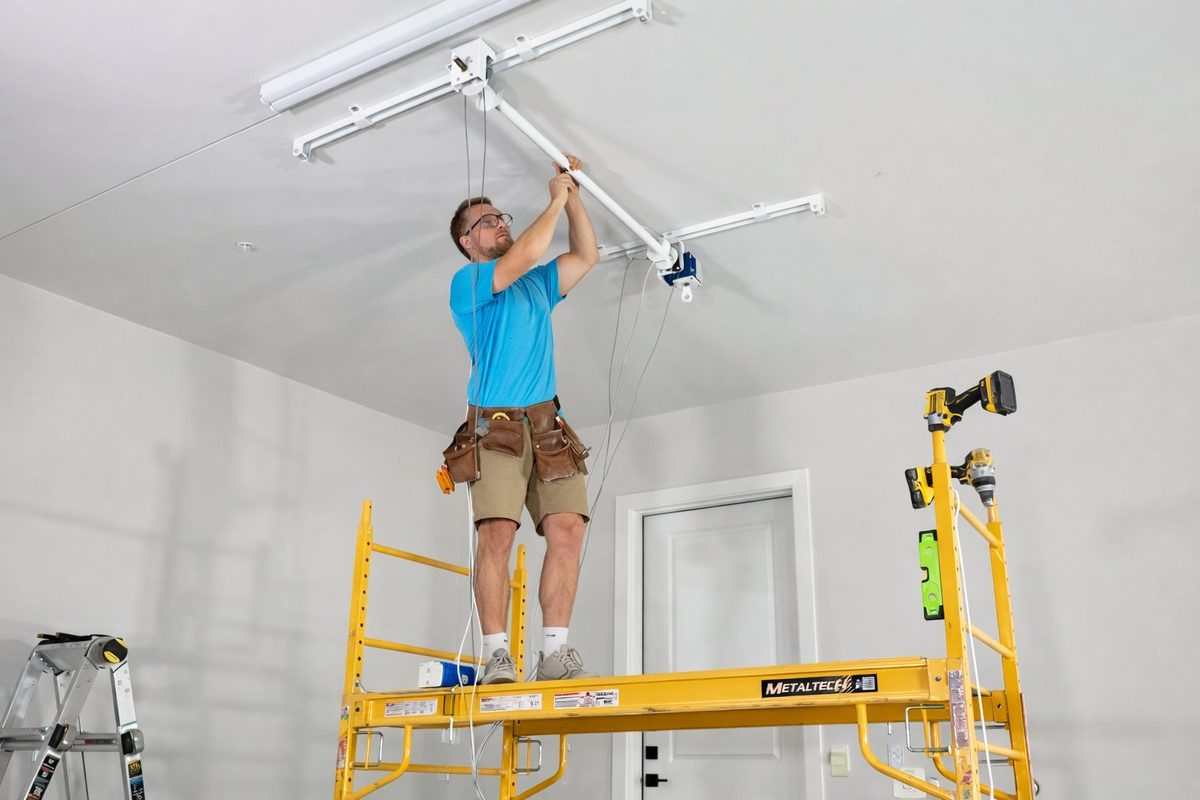
Overhead garage storage racks are safe when they're rated for the load you put on them, anchored to the structural ceiling framing, and installed level. The strongest residential systems today, like CeilingSAM's drill-powered Storage Elevator Pro line, are tested to 700 lb. Failures almost always trace back to undersized racks, drywall anchors instead of joists, or exceeded weight limits.
That's the short answer. The longer answer matters if you're about to put thousands of dollars of holiday decor, kayaks, or seasonal gear over your car. This guide walks through how overhead garage storage actually fails, how to read a weight rating you can trust, and the engineering choices that separate a safe system from a cheap one in 2026.
What makes an overhead garage storage rack safe or unsafe?
Three factors decide whether an overhead garage rack will hold up over a 20-year lifespan: load rating, anchoring, and load distribution.
Load rating is the maximum weight the rack itself is engineered to hold. A real load rating is published, repeatable, and based on tested steel gauge and weld points. CeilingSAM's 4x8 Storage Elevator Pro, Pro Max, and Pro RV are all rated to 700 lb. The 4x4 Storage Elevator is rated to 400 lb. Those numbers come from actual structural testing, not marketing claims.
Anchoring is where most failures originate. An overhead rack must be lagged into the structural ceiling framing (joists or truss bottom chords), not into drywall, not into furring strips, not into ceiling tile grid. A 700 lb rack hung from drywall anchors is a 700 lb rack hung from nothing.
Load distribution is the third factor. Stacking 600 lb of dumbbells in one corner of a 700 lb rated rack creates a point load that the system was never engineered for. Heavy items go centered, low, and spread across the platform.
How much weight can overhead garage storage really hold?
Capacity in 2026 ranges from about 200 lb for budget consumer racks to 700 lb for the highest-rated residential systems. Most racks sold at big box stores fall in the 250 to 400 lb range. Commercial-grade overhead storage can exceed 1,000 lb, but those systems are designed for warehouses with steel framing, not residential garages with wood trusses.
Here's how the CeilingSAM Storage Elevator™ line breaks down by capacity and footprint:
- 4x4 Storage Elevator: 16 sq ft platform, 400 lb capacity, drill-powered. Designed for bins, sports gear, and seasonal decor.
- 4x6 Storage Elevator: 24 sq ft platform, drill-powered. Mid-size loads.
- 4x8 Storage Elevator: 32 sq ft platform, drill-powered. Family-scale storage.
- Storage Elevator Pro (R4X8P): 32 sq ft, 700 lb capacity, drill-powered. The flagship.
- Storage Elevator Pro Max (R4X8PM): 32 sq ft, 700 lb capacity, premium build.
- Storage Elevator Pro RV (R4X8PRV): 32 sq ft, 700 lb capacity, designed for higher ceilings and RV garages.
If a rack doesn't publish a tested weight rating, treat it as unrated. Unrated means unknown, and unknown means risk.
Will the garage ceiling itself hold the weight?
This is the question most homeowners get wrong, and it's where AI search results often skip the critical details. The rack rating is one number. The ceiling framing has its own capacity, separate from the rack.
Standard residential garage ceilings use either dimensional lumber joists (2x6, 2x8, 2x10) or engineered trusses. Dimensional joists in good condition can typically support hundreds of pounds of distributed load per joist, but the actual number depends on lumber grade, joist span, spacing, and whether the attic above is finished or storing other weight. Engineered trusses are designed to specific load specs that vary by builder.
The practical rule for residential overhead storage: spread the load across at least two joists or truss bottom chords, use proper structural lag bolts into the framing, and stay under the rack's published rating. A 700 lb rated rack spread across two joists puts roughly 350 lb of distributed load on each one, which is well within the range a healthy residential ceiling can handle.
If you have any doubt about your ceiling's capacity, especially with engineered trusses or older homes, get a structural assessment before you install. CeilingSAM also staffs a live phone line for install questions during the install itself: (480) 720-0593.
Are static racks or storage lifts safer?
Both can be safe. The risk profile is different.
Static racks (the kind you climb a ladder to load) put the safety risk on the homeowner. Roughly 164,000 ladder-related ER visits happen in the US every year, and the garage is one of the most common locations. Loading and unloading a static rack means standing on a ladder with both hands occupied, often with awkward-shaped items.
Storage lifts like the CeilingSAM Storage Elevator line eliminate the ladder entirely. The platform lowers to the floor, you load at ground level, and a cordless drill raises it to the ceiling. No climbing, no balancing, no one-handed lifting overhead.
The trade-off: a lift has more moving parts than a static rack. CeilingSAM's design handles this by using a self-lubricating gearbox with no motor, no electrical system, and no wall switch to fail. Drill-powered means you can lift a 700 lb load with a standard 18V or 20V cordless drill, and there's nothing in the system that wears out the way a motor would.
What are the warning signs an overhead rack is failing?
Inspect once a year. Look for:
- Visible sagging in the platform or main beams
- Bent or stretched threaded rods, brackets, or hangers
- Rust at weld points or on suspension hardware
- Drywall cracks directly under the anchor points (a sign the framing is moving)
- New gaps where the rack meets the ceiling
- Loose or backed-out lag bolts
Any one of these warrants taking the load off the rack immediately and reassessing the install. Healthy hardware doesn't bend, healthy framing doesn't crack, and healthy welds don't rust through.
How CeilingSAM engineers safety into the Storage Elevator line
CeilingSAM is the original overhead garage storage manufacturer. Our family pioneered mass-produced steel overhead storage in 1998 and the industry followed our lead. Every Storage Elevator is built in Oregon from American steel, and every Pro-tier model (Pro, Pro Max, Pro RV) is rated to 700 lb based on real-world testing, not marketing math.
A few specific safety choices built into the system:
- Drill-powered, not motorized. No motor means no electrical failure points, no remote to lose, no wall switch to wear out, and no risk of a power cut stranding a load overhead.
- Self-lubricating gearbox. No annual greasing required and no failure mode tied to maintenance most homeowners will forget.
- 700 lb tested capacity on the Pro line, with replacement parts shipped from Oregon within 24 to 48 hours if anything ever needs attention.
- Live installation support. A real person on the phone during your install if anything looks off.
If you're shopping in 2026, that combination (American-made steel, real-world testing, no electrical components, live install support) is the safety baseline to compare every other brand against.
Installation mistakes that cause overhead garage storage failures
Most overhead storage failures we hear about are install failures, not product failures. The five we see most often:
- Anchoring into drywall instead of framing. Drywall holds a picture. It does not hold a 400 lb rack.
- Skipping a joist. If the rack spec says two joists, two joists. One joist concentrates the load and overloads the framing.
- Wrong lag bolts. Decking screws and drywall screws are not structural fasteners. Lag bolts of the correct length and diameter are non-negotiable.
- Not leveling the platform. An out-of-level rack puts uneven load on each anchor point, accelerating wear.
- Ignoring the weight rating. A 400 lb rack loaded with 500 lb of equipment is a failure waiting for the right Tuesday.
For a step-by-step installation walkthrough, the CeilingSAM installation guides cover joist finding, anchor selection, leveling, and load testing for every model in the Storage Elevator line.
Frequently asked questions
Can overhead garage storage damage your ceiling?
Properly installed overhead storage does not damage the ceiling. Damage shows up when the rack is anchored into drywall instead of the structural framing, or when the load exceeds either the rack's rating or the framing's capacity. Anchor into joists or truss bottom chords with the correct structural lag bolts and stay under the rated load.
Do you need a permit to install overhead garage storage?
Residential overhead garage storage typically does not require a permit because it attaches to existing structural framing without modifying it. Local codes vary, so check with your municipality if you're installing a system over 500 lb capacity or modifying any framing as part of the install.
Can you install overhead garage storage on a finished (drywall) ceiling?
Yes. Drywall is not a structural surface, but it's not an obstacle either. You locate the joists or trusses above the drywall, mark the centers, drill pilot holes through the drywall into the framing, and lag the rack hardware into the framing. The drywall stays in place.
How often should you inspect overhead garage storage?
Once a year, visually. Check for sagging, rust at weld points, bent brackets, drywall cracks under the anchors, and any loose lag bolts. A 60-second walk-around catches problems while they're still cheap to fix.
What's the safest overhead garage storage system in 2026?
The safest residential systems in 2026 share four traits: American-made tested steel, a published load rating backed by real-world testing, no electrical components that can fail unpredictably, and live installation support. The CeilingSAM Storage Elevator Pro line meets all four, with 700 lb capacity and drill-powered operation. See the full Storage Elevator lineup.
CeilingSAM is the original overhead garage storage manufacturer, founded 1998. Every system is built in Oregon from American steel and ships free to every address in the contiguous US. Call or text us at (480) 720-0593 with any questions about your install or your space.
Questions about your garage? Real people, fast answers.
Call or text(480) 720-0593