


Bike Hook Guide: How to Choose and Install the Best Wall Mount for Your Bicycle
Bikes are awkward to store. They're too big to stash in a corner, they tip over when leaned against a wall, and they take up floor space that most garages and apartments simply can't spare. The good news is that one relatively simple upgrade — a bike hook — can solve all of that at once.
A bike hook lets you lift your bicycle off the floor, hang it securely on a wall or ceiling, and reclaim the square footage underneath. But not all hooks are equal, and the right solution depends on your space, your bike type, and how often you actually ride.
This guide covers everything you need to know about bike hooks and wall mounts — from the different types available to installation tips, weight considerations, and how to think about storage when you have more than one bike to deal with.
Why a Bike Hook Is One of the Smartest Storage Investments You Can Make
A standard adult bicycle takes up roughly 6 square feet of floor space when parked flat. Multiply that by two, three, or four bikes — common in a family with active riders — and you've eaten a significant chunk of your garage, mudroom, or entryway before you've stored anything else.
Wall mounting or ceiling mounting a bike solves this immediately. When a bike hangs on a wall hook, it occupies almost no floor space. The footprint essentially shrinks to the wall anchor itself. That's a dramatic improvement in how usable your space feels, especially in garages where every inch counts.
Beyond space savings, hanging bikes also protects them. Bikes propped against walls or floors are constantly at risk of being knocked over, scratched, or damaged by other items falling on them. A properly installed bike hook wall mount holds the bike securely in place, keeping it off the ground and away from the general chaos of a busy storage space.
Types of Bike Hooks and Wall Mounts
There's a wide range of options when it comes to bicycle wall mounts and hooks. Understanding the differences will help you find the right fit for your situation.
Single Horizontal Bike Hook
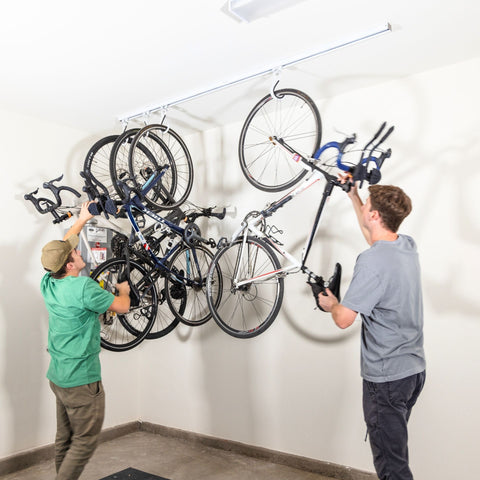
The most basic option: a single hook that holds the bike horizontally by one wheel, with the frame resting against the wall at an angle. These are inexpensive and easy to install, but they can put stress on the wheel rim over time and tend to let the bike swing around unless the front wheel is also secured. They work fine for occasional storage but aren't ideal for everyday use or multiple bikes.
Vertical Wall Mount Bike Hook
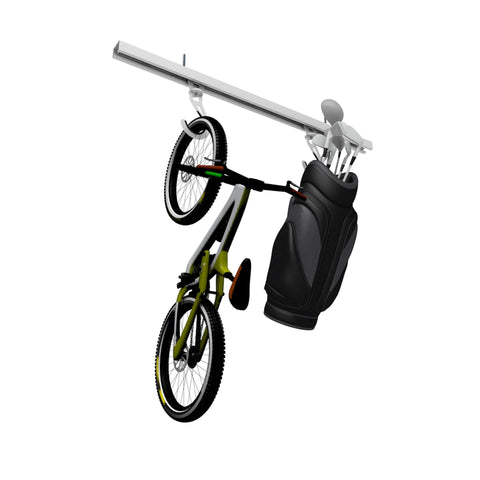
A vertical wall mount bike hook holds the front wheel straight up, with the rest of the bike hanging down close to the wall. This is one of the most space-efficient wall-mounted bike storage options available — a bike stored vertically takes up less than a foot of wall width. The trade-off is that lifting a heavy bike straight up can be awkward, especially for heavier e-bikes or cargo bikes.
Horizontal Frame-Cradle Mounts
These wall racks for bikes support the frame itself (usually at the top tube) rather than relying on the wheel. Frame cradles are gentler on the bike and keep it level, which makes it easier to hang and retrieve. They're a popular choice for riders who store bikes they care about and want to avoid putting any stress on wheel rims or tires.
Foldable / Swing-Out Bike Wall Mounts
Folding or swing-arm bike wall mounts let you push the bike flat against the wall when not in use, then swing it out to access it easily. These are particularly popular in apartments and tight spaces where you're working around furniture or doorways. They add some mechanical complexity but make a big difference in spaces where every inch of clearance matters.
Ceiling-Mounted Bike Storage (Sliding Systems)
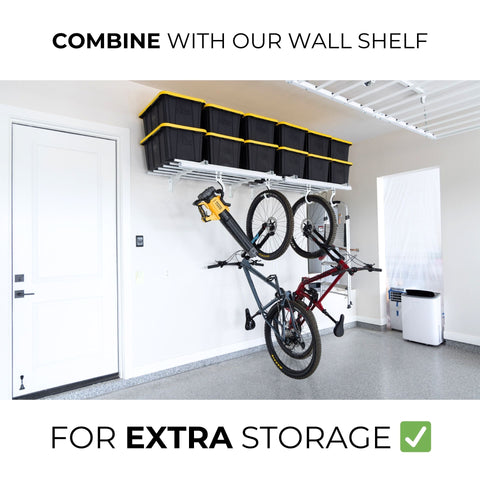
For garages with adequate ceiling height, ceiling-mounted bike storage eliminates the need to use wall space at all. Instead of hanging bikes on a wall hook, you mount them overhead on a sliding track system — the bikes tuck up near the ceiling when stored and slide out for access when needed.
Ceiling SAM's Bike Slide and Bike Slide Pro are purpose-built ceiling storage systems for bicycles. Both mount to ceiling joists and use a sliding track so you can store multiple bikes overhead without them tangling or interfering with each other. The Bike Slide Pro is particularly well-suited for families with several bikes, offering more capacity and a heavier-duty build. For garages where wall space is already in use — or where you want to preserve wall space for tools, shelving, or other storage — the ceiling approach is hard to beat.
Wall Mounted Bike Hook: What to Look for Before You Buy
Not every bike hook wall mount is built the same, and a few key factors will determine whether you end up with a storage solution that actually works long-term or one that wobbles, scratches your bike, or pulls out of the wall.
Weight Capacity
Most adult bikes weigh between 20 and 30 pounds. E-bikes and cargo bikes can easily hit 50, 60, or even 70+ pounds. Make sure any wall mount for bike storage you're considering is rated for your specific bike's weight — with some margin to spare. Don't assume a basic hook rated for 30 lbs is fine for a 28-lb bike; load ratings are maximums, not targets.
Wall Anchor and Stud Compatibility
A bike hook wall mount is only as strong as the anchor point it's fastened to. For a single hook holding 20-30 lbs, a solid stud mount is sufficient. For heavier bikes, multiple hooks, or ceiling systems, you want anchors going directly into structural framing — joists or studs — not just drywall. Drywall anchors can fail under sustained load, especially with the vibration and occasional impact that comes with active use.
Bike Frame Compatibility
Some hooks only work with standard diamond-frame bikes. Others accommodate step-through frames, kids' bikes, and non-standard geometry. If you have a mix of bike types in your household, look for a system flexible enough to handle all of them without requiring a different mounting hardware for each.
Padding and Finish Protection
Any part of a bike hook or mount that contacts the frame or wheel should be padded or coated to prevent scratches. This is especially important for bikes with painted frames, carbon fiber components, or expensive finishes. Look for rubber-coated hooks, foam padding, or felt-lined cradles if protecting your bike's finish is a priority.
Ease of Use
The most elegant bike wall hanging solution is one you'll actually use every time. If hanging your bike requires two hands, a specific lifting technique, and three minutes of effort, you'll start leaving the bike on the floor "just this once" — and it'll live there permanently. Think about how you physically put the bike away and retrieve it, especially if you ride frequently.
Bike Hook Installation: A Practical How-To
Installing a wall mount bike hook is a straightforward DIY project for most homeowners. Here's how to approach it correctly.
Step 1: Find Your Studs
Use a reliable stud finder to locate the studs or joists in your mounting surface. In most homes, wall studs are 16 or 24 inches on center. Mark the center of at least one stud at the height you want to mount the hook. For a standard horizontal bike hook, a height of 6-7 feet off the floor works well for most adult bikes.
Step 2: Choose Your Mount Height Carefully
Think about clearance. A horizontally mounted bike will stick out 1.5 to 2+ feet from the wall depending on frame size. Make sure there's nothing in the bike's swing path — shelves, other bikes, car doors, or overhead door tracks. If you're mounting multiple bike hooks in a row, space them at least 18-20 inches apart to prevent handlebars from overlapping.
Step 3: Pre-Drill and Use the Right Hardware
Pre-drilling into wood studs makes fastener installation cleaner and reduces the risk of splitting. Use lag screws or heavy-duty wood screws of appropriate length — typically 2.5 to 3 inches for a stud mount. Avoid drywall-only anchors for anything over a lightweight 15-lb bike.
Step 4: Test Before Trusting
Once installed, test the mount by applying firm downward and outward pressure before you hang the bike. The hook should feel completely solid with zero movement. A little flex is a warning sign — check your anchors and re-fasten if needed.
For Ceiling Systems
Ceiling-mounted bike storage like the Ceiling SAM Bike Slide requires anchoring into ceiling joists rather than wall studs. The same principles apply: find the structural framing, use appropriate hardware, and test the system under load before trusting it with your bikes. Ceiling SAM provides installation guides to walk you through the process, and their installer network is available if you'd prefer a professional setup.
How Many Bikes? Thinking Through Multi-Bike Storage
Single-bike households can usually get by with a single wall-mounted bike hook. But the moment you're dealing with two or more bikes — a couple's bikes, a family setup, or a dedicated cyclist's quiver — the equation changes quickly.
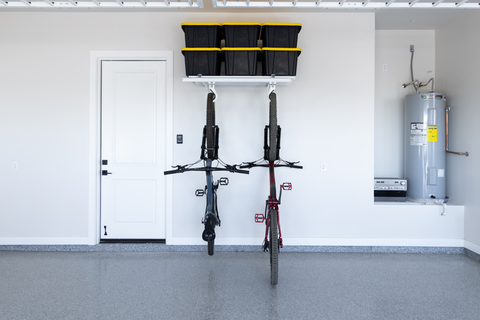
The main challenge with multiple bikes on wall hooks is the footprint. Even with compact mounts, four bikes on a wall require substantial horizontal space. Handlebars overhang, pedals catch on each other, and accessing one bike often means moving others first.
A few approaches work well for multi-bike storage:
Staggered heights: Mount hooks at alternating heights so bike frames and handlebars don't overlap. This works best with 2-3 bikes of similar size.
Vertical mounts side by side: Vertical wall mount bike hooks take up less horizontal wall width than horizontal hooks, making them more efficient when wall space is the constraint.
Ceiling sliding systems: For four or more bikes, a ceiling-mounted sliding system like the Bike Slide Pro is often the cleanest solution. Bikes slide along a ceiling track, each one accessible independently without moving the others. This also completely frees up wall space for other storage.
Bike Storage in Tight Spaces: Apartments, Small Garages, and Shared Storage
Not everyone has a two-car garage to work with. If you're storing bikes in an apartment, a small mudroom, or a shared building storage area, the constraints are tighter but the principles are the same.
Apartments
In an apartment, a vertical wall mount bike hook is often the best option — it minimizes the horizontal footprint and keeps the bike tight against the wall. Install into a wall stud where possible; if studs aren't accessible, use heavy-duty toggle bolts rated for the bike's weight. Consider the visual impact too: a bike hanging on a wall can be a design feature or an eyesore depending on the mount hardware and your space.
Small Garages
In a small garage, vertical space is your best friend. The walls above eye level and the ceiling are almost always underutilized. A wall-mounted bicycle wall mount at high height keeps the bike out of the way of car doors and foot traffic. If ceiling height allows, a ceiling system like the Bike Slide moves bikes completely off the walls, leaving that space available for shelving, tools, or a workbench.
Shared or Communal Storage
Shared building storage areas often have limited wall space that multiple residents need to use. In these situations, compact wall-mounted bike hooks that fold flush when not in use are particularly valuable — they take up space only when a bike is actually on them.
Combining Bike Storage with the Rest of Your Garage Organization
Bike storage rarely exists in isolation. Most garages need to handle bikes alongside bins, tools, sports equipment, seasonal gear, and vehicles. The most effective approach treats bike storage as one component of a broader system rather than an afterthought.
If your garage already has overhead ceiling racks for seasonal storage, pairing them with a ceiling bike storage system creates a cohesive overhead organization layer — gear and bins up top, floor cleared for vehicles and workspace.
Ceiling SAM's product lineup is designed with this kind of layered approach in mind. Overhead racks like the 4x4, 4x6, and 4x8 Heavy-Duty Ceiling Storage Racks handle bins and bulky seasonal items, while the Bike Slide and Bike Slide Pro take care of bicycles — all mounted to the ceiling, all keeping your floor and walls free. If you also need wall-level storage, the Garage Storage Wall Shelf and Wall Shelf Combo round out the system without cluttering your bike storage zones.
Common Mistakes to Avoid with Bike Hooks and Wall Mounts
A few pitfalls come up repeatedly with bike storage installations. Being aware of them ahead of time will save you a reinstall.
Mounting into drywall only. Always anchor into studs or joists for anything beyond the lightest bikes.
Ignoring clearance. Measure the bike's full width including handlebars and pedals before deciding on hook placement. Many people install hooks that put the bike directly in the path of a car door or garage door track.
Spacing hooks too close together. If storing multiple bikes side by side on wall hooks, give each bike at least 18-20 inches of horizontal space to avoid handlebar collisions.
Forgetting about retrieval. The easiest bike to hang is also the hardest to take down if you chose the wrong hook type for your bike's weight or geometry. Test the motion before committing to a mount location.
Overlooking ceiling options. Many people default to wall hooks without considering that their ceiling — especially in a garage — might offer more usable space and better access for multiple bikes.
Final Thoughts
A bike hook is one of those upgrades that has an outsized impact on how usable your space feels. Getting bikes off the floor frees up room, reduces clutter, and protects your equipment. The right solution depends on how many bikes you're storing, what kind of wall or ceiling space you have, and how often you need to access them.
For single bikes or light-use scenarios, a well-anchored wall mounted bike hook does the job cleanly. For families with multiple bikes, or for anyone who wants to maximize their garage without eating up wall space, a ceiling-based sliding system is worth considering as part of a broader garage organization approach.
Explore Ceiling SAM's bicycle storage solutions to see what fits your space — and take a look at the full lineup of overhead garage storage options if you're ready to tackle the whole garage at once.


