

Smart Garage Storage: Why Ceiling-Suspended Elevators Are the Smartest Choice
Key Takeaways
The smartest garage storage uses otherwise wasted ceiling space, freeing up the entire floor for cars, workbenches, and walking paths.
Ceiling-suspended garage elevators without motors avoid common failure points, making them more reliable than typical motorized lifts and hoists.
High-quality, American-made components (steel cables, pulleys, and hardware) ensure long-term durability and smooth, safe operation.
Ceiling storage elevators are ideal for bulky, seasonal items like holiday décor, camping gear, and sports equipment that don’t need daily access.
A smart garage storage plan integrates ceiling elevators with wall systems, clear walkways, and logical storage zones for vehicles, tools, and hobbies.
Introduction: What Makes Garage Storage “Smart” Today?
About one in three U.S. homeowners can’t park at least one car in their garage because of clutter. That statistic alone reveals how many garages have drifted from their original purpose into chaotic holding areas for everything from holiday decorations to forgotten power tools.
Smart garage storage goes beyond simply adding more shelves or hooks. It refers to systems that maximize cubic space, including floor, walls, and especially the ceiling, while remaining reliable for 10 to 20 years with minimal maintenance. The goal is to create an organized garage that actually functions as intended: a place for vehicles, a workspace for projects, and accessible storage for household items.
Ceiling-mounted garage elevators built with American-made, non-motorized mechanisms are emerging as a particularly smart solution. These systems combine high capacity with safety and an extremely low failure risk. Unlike motorized alternatives that can burn out or malfunction, a well-built mechanical elevator relies on time-tested engineering that simply works.
This article will focus on ceiling-suspended storage as the core smart choice, then cover how to integrate it with other organization solutions. You’ll learn why going overhead makes sense, what distinguishes quality components from generic imports, and how to plan a garage layout that feels organized and stays that way.

The Overhead Advantage: Turning Ceiling Space into Storage
A typical two-car American garage measures about 20 feet by 20 feet with 9-foot ceilings. That translates to over 3,600 cubic feet of total volume—yet most of that space above hood height sits completely unused. While homeowners stack bins against walls and crowd the garage floor with seasonal gear, thousands of cubic feet overhead remain empty.
Ceiling storage removes bulky items from floors and corners, making it dramatically easier to park vehicles, open car doors without bumping into clutter, and move tools between dedicated zones. When the floor is clear, a garage transforms from a frustrating obstacle course into a genuinely functional room.
Fixed overhead racks have been available for years, but they require ladders every time you need to access stored items. This creates both inconvenience and safety concerns, particularly when lifting heavy labeled bins or awkward camping equipment. Elevator-style platforms that travel up and down eliminate the need to climb at all. You simply lower the platform to waist height, load or unload, and raise it back to the ceiling.

Appropriate items for overhead storage include artificial Christmas trees, large coolers, camping totes, off-season sports equipment like skis and kayaks, archive boxes, and anything else that takes up significant space but only gets used a few times per year. These bulky items consume precious floor space when stored at ground level but pose no inconvenience when suspended eight feet overhead.
Why Non-Motorized Ceiling Elevators Are the Smartest Choice
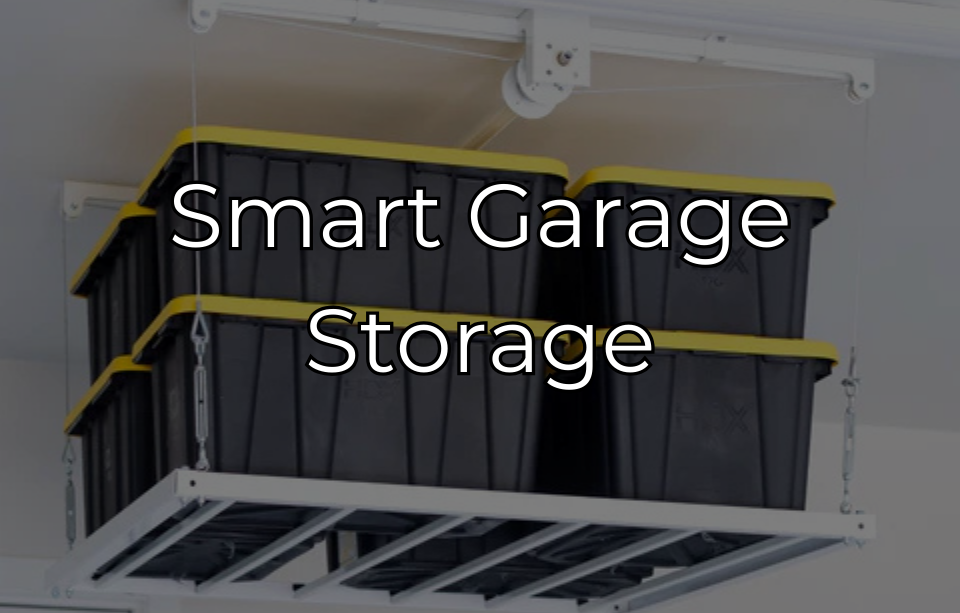
A garage ceiling elevator consists of a steel platform suspended from ceiling joists that lowers to waist height using cables, pulleys, and either a hand crank or drill-operated mechanism. The platform rises and descends smoothly along a vertical path, allowing you to store and retrieve items without climbing ladders or stretching overhead.
In this context, smart means mechanically simple, failure-resistant, and easy to operate safely—not necessarily app-controlled or electronic. While smart home technology has its place, garage environments present unique challenges that make electronics less reliable. Temperature swings from below freezing to above 100°F, dust, humidity, and vibration all take a toll on motors and circuit boards.
Systems without motors have fewer wear points. There are no gearboxes to strip, no electronics to short out, and no remote controls to fail or lose. This simplicity is critical in unconditioned garages where temperature extremes would stress powered components year after year.
Quality American-made components—precision pulleys, thicker-gauge steel brackets, and robust hardware—are better suited to support loads of 300 to 600 pounds year after year. When a storage system hangs above your vehicles and workspace, the quality of every component matters.
Reliability: No Motor, No Burnout
Motorized lifts can suffer from burned-out motors, stripped gears, and failed limit switches, often within five to ten years depending on use and environment. Industry estimates suggest motorized ceiling lifts experience failure rates of 10 to 15 percent within the first five years. In a dusty, humid garage, electronics degrade two to three times faster than in climate-controlled spaces.
Non-motorized elevators rely on basic mechanical advantage. As long as the cables, pulleys, and anchoring hardware remain sound, these systems stay functional for decades with minimal maintenance. There are simply fewer things that can go wrong. A pulley system with a 4:1 ratio reduces the force needed to lift a load by 75 percent, meaning one person can smoothly raise a 400-pound platform with reasonable effort.
American-made cable and pulley assemblies are often rated for loads well above typical residential needs, and quality systems are tested to safety factors exceeding their stated capacity. Consider a family installing a non-motorized ceiling elevator in 2026—with periodic inspections and basic care, that same system can realistically remain in service through the mid-2040s and beyond.

Safety and Ease of Use
Non-motorized elevators typically incorporate mechanical locks, safety latches, or redundant cable paths so the platform cannot free-fall if a single component fails. This built-in redundancy provides peace of mind when storing heavy items overhead.
Many designs operate with a hand crank or standard cordless drill, allowing smooth, controlled movement up and down without sudden starts or stops. By keeping the mechanism purely mechanical, there is no risk of accidental activation via a remote, power surges, or tripped breakers interrupting operation mid-travel.
Smart storage means people of varying strength can safely operate the system. Gear ratios are chosen so an average adult can gradually raise several hundred pounds. If using a cordless drill, the process takes only seconds and requires minimal physical exertion. This accessibility ensures the storage solution actually gets used rather than becoming an ignored feature.

Build Quality: American-Made Components That Last
American manufacturing standards and traceable steel and hardware sourcing help ensure consistent quality in structural parts used overhead. When components are fabricated domestically, they typically adhere to stricter ASTM standards for tensile strength—often exceeding 50,000 psi yield—and undergo more rigorous quality control.
U.S.-made steel brackets, mounting plates, and fasteners are designed to resist bending, fatigue, and corrosion better than many generic imported kits. Overseas alternatives often use plastic composites or thinner-gauge steel that degrades under UV exposure or humidity, potentially developing rust issues within five to ten years.
Climate-resistant finishes like powder-coated steel and zinc-plated hardware are particularly important in garages exposed to road salt, seasonal humidity, and condensation. American-made systems with galvanized finishes can maintain corrosion resistance for 30 years or more.
For any load-bearing system positioned above people and vehicles, investing in higher-grade, American-made parts is a conservative, safety-oriented decision rather than a luxury. Systems built with 10 to 12 gauge steel and tested load ratings provide the structural integrity that overhead storage demands.

Planning a Smart Ceiling Storage Layout
Before installation, measure your garage carefully. Note the ceiling height, joist direction, and any obstructions such as garage door openers, light fixtures, attic hatches, and sprinkler heads. These measurements determine where an elevator platform can travel without interference.
Smart elevator placement usually means positioning the platform centered over clear floor space or just ahead of parked cars. This allows the platform to lower fully without hitting vehicles when you need access. Consider how car doors swing open and whether the lowered platform would block movement.
Leave at least 18 to 24 inches of clearance from the lowest position of the platform to the floor. This prevents the platform from blocking walkways and tool chests when lowered. You need room to walk around the platform and load items comfortably.
Choose platform dimensions based on your available ceiling grid and typical storage bins. A 4-foot by 4-foot platform works well for seasonal bins and holiday decorations, while a 4-foot by 8-foot platform can accommodate longer items like skis, fishing rods, or folding tables. Match the platform size to your actual storage needs rather than simply choosing the largest option.

What to Store on a Ceiling Elevator (and What Not To)
Appropriate items for ceiling elevator storage include labeled plastic totes of holiday décor, camping gear, off-season clothing, spare car parts, folding tables, and lightweight furniture. These items share common characteristics: they’re bulky enough to consume valuable floor space, used infrequently enough that occasional raising and lowering is acceptable, and safe to store overhead.
Hazardous materials should never be stored overhead. Gasoline, solvents, propane cylinders, and similar items belong at ground level in ventilated cabinets. Fumes can accumulate in ceiling areas, and the fire risk is simply not worth the space savings.
Limit fragile or frequently used items overhead. If you access something weekly, wall space or floor-level shelving makes more sense. Smart use focuses on belongings that justify the occasional platform operation—typically seasonal gear cycled a few times per year.
Long items like skis, snowboards, and fishing rods can be strapped to the platform frame or placed in long bins to prevent shifting when raising the elevator. Secure loose items before lifting to prevent anything from falling during travel.
Integrating Ceiling Elevators with Walls, Floors, and Zones
A truly smart garage divides space into functional zones: vehicle parking, tools and workbench, lawn and garden supplies, sports equipment, and overhead seasonal storage. Each zone serves a distinct purpose, and items belong in their designated areas.
Ceiling elevators should complement, not replace, other garage storage systems. Wall-mounted slatwall panels, pegboards, magnetic strips for small tools, and cabinet runs along side walls all have their place. The ceiling handles bulk and seasonal items while walls manage daily-use tools and frequently accessed gear.
Consider a standard two-car garage layout: the ceiling elevator positioned above the front of both parked cars, slatwall on the right wall for tools and hooks, bike hooks on the left wall, and a compact workbench at the back wall near the house entry. This arrangement keeps the garage floor open for vehicles while putting everything within logical reach.
Clear floor paths between the entry door, vehicles, and work areas are a primary sign that smart storage is working effectively. When you can walk through the garage without navigating around obstacles, the system has achieved its purpose.
Combining Elevators with Wall Systems
When a ceiling elevator is present, wall storage beneath or beside its travel path must stay low-profile to avoid collision. Focus taller cabinets on opposite walls where the platform never descends.
Use wall-mounted track or slat systems for frequently accessed tools and gear. This way, the ceiling elevator handles rarely used items while walls keep everyday supplies accessible. Slatwall can support 50 to 75 pounds per hook, making it ideal for hand tools, extension cords, and similar items.
A concrete arrangement example: wall tracks mounted at 4 to 6 feet height for rakes, shovels, and garden tools; drawers and cabinets below for chemicals and supplies; and the ceiling elevator directly above an open floor area where vehicles park. This layered approach—ceiling for bulk and seasonal storage, walls for regular use, floor for work zones—keeps the garage intuitive and easy to maintain.

Installation and Structural Considerations
Any ceiling elevator carrying hundreds of pounds must be anchored directly into structural members—joists or trusses—never just drywall or furring strips. The structural connection is the most critical aspect of safe installation.
Many U.S. garages built after about 1990 use engineered trusses rather than traditional joists. Installers should confirm load capacity and never cut or notch truss members without an engineer’s approval. Modifying trusses can compromise the entire roof structure.
Typical mounting methods include lag screws or through-bolts with backing plates. Following manufacturer instructions and local building codes is essential. Most quality systems specify hardware sizes, spacing requirements, and load distribution guidelines that must be observed.
Even non-motorized elevators benefit from periodic inspection—ideally once a year—of cables, pulleys, and fasteners for wear, rust, or loosening. This simple maintenance ensures continued safe operation and catches potential issues before they become problems.

DIY vs. Professional Installation
Experienced DIYers comfortable with ladders, power tools, and load-bearing fasteners can sometimes install non-motorized elevators themselves, provided they follow detailed instructions. A successful DIY installation requires accurate joist location, proper hardware, and careful attention to level and alignment.
Professional installation is strongly advisable when ceiling height exceeds about 10 feet, truss layouts are complex, or there is uncertainty about roof structure. Professionals can confirm joist or truss orientation, use appropriate hardware, and ensure the platform travels smoothly without binding.
Professional installers typically charge between $500 and $1,500 for ceiling elevator installation, depending on complexity and region. This investment provides assurance that the system is mounted correctly and safely.
Smart storage is not just about the product—it’s also about correct installation that preserves long-term safety and performance. A quality elevator mounted improperly creates risks that no amount of component quality can overcome.
Maintaining a Smart, Clutter-Free Garage Over Time
The smartest storage system still fails if items aren’t periodically reviewed. A yearly “garage audit” every spring or fall helps prevent gradual clutter accumulation. During this review, decide what to keep, donate, or discard.
A simple maintenance schedule keeps everything running smoothly: inspect ceiling elevator hardware once a year, reorganize bins before peak seasons (holiday décor in October, camping gear in April), and donate items that haven’t been used in two years. This rhythm prevents the slow drift back toward chaos.
Labeling best practices make ceiling storage more practical. Use durable labels on tote ends that remain readable from floor level. This allows you to identify what’s on the overhead platform without lowering it unnecessarily. Clear labeling transforms a ceiling elevator from a mystery storage area into an organized extension of your home.
Smart use patterns do more for long-term garage organization than buying extra products. Putting items back in their designated zones after weekend projects maintains the system you’ve created. The garage stays organized because habits support the infrastructure, not because you’ve purchased more storage solutions.
FAQ
How much weight can a typical non-motorized garage ceiling elevator safely hold?
Well-designed residential platforms commonly support between 300 and 600 pounds of evenly distributed load, depending on the model and structural conditions in the garage. The specific rated capacity provided by the manufacturer must be followed—this isn’t a suggestion but a safety limit.
Structural limits of the garage framing can be just as important as the platform’s own rating. A platform rated for 500 pounds doesn’t help if the ceiling joists can only handle 300 pounds of concentrated load. Always leave a safety margin rather than loading right up to the stated maximum, especially when storing dense items like books, tools, or boxes of tiles.
Exceeding rated loads can cause cable stretch, uneven lifting, or damage to ceiling members over time. Homeowners planning to store near the upper limits of capacity may wish to consult a structural professional before proceeding.
Can ceiling storage elevators be used in older garages with low ceilings?
In many older garages with 8-foot ceilings, a compact ceiling elevator is still possible, but the vertical travel distance is limited. Platforms in low-ceiling spaces may only rise 18 to 24 inches above head height, which still clears vehicles and walkways but offers less hidden overhead volume.
Measure from floor to ceiling, then subtract the tallest planned vehicle height and at least several inches of clearance. This calculation determines practical platform thickness and travel distance. In very low or obstructed ceilings, wall-based systems and shallow overhead racks might be a better primary strategy.
Any installation in an older structure should include careful inspection of joists for age-related issues like rot, insect damage, or previous modifications that may have weakened the framing.
Do non-motorized elevators require a lot of physical strength to operate?
Properly geared mechanical systems are designed so an average adult can raise and lower a loaded platform using a hand crank or cordless drill at a reasonable pace. The pulley ratios—typically 4:1—reduce the required force by about 75 percent, making the system accessible to most users.
Using an 18V or 20V cordless drill on a recommended speed setting significantly reduces effort while maintaining control. Many homeowners find drill operation faster and easier than hand cranking, particularly for heavier loads.
If the platform feels excessively hard to move, this can indicate overloading, friction in pulleys, or alignment issues that should be inspected before further use. Households with users of different strengths may prefer platforms with higher mechanical advantage and slightly slower travel speeds.
What happens if the power goes out? Can I still use a non-motorized elevator?
Non-motorized elevators are fully functional during power outages because they rely on mechanical force rather than electric motors. Users can continue to operate the system with a hand crank or any battery-powered drill kept charged for other household tasks.
Keep the crank handle in a consistent, easy-to-find location near the platform so it’s always available when needed.
How often should I inspect or service a ceiling elevator system?
A quick visual check every few months catches obvious issues—frayed cables, rust on hardware, loose fasteners, or unusual noises during operation. These brief inspections take only a few minutes and provide early warning of potential problems.
Schedule a more thorough inspection once a year, ideally at the same time as other home maintenance tasks. Tighten bolts, check that the platform remains level, and lightly lubricate moving parts if allowed by the manufacturer. American-made systems with quality components typically require minimal intervention beyond these basic steps.
Immediately discontinue use if any component appears damaged or if the platform no longer raises evenly. With basic preventative care, a high-quality non-motorized system can serve reliably for decades in a typical residential garage. Keeping a simple maintenance log helps track any changes over time and supports continued safe use.
Questions about your garage? Real people, fast answers.
Call or text(480) 720-0593