

SafeRacks vs. Monkey Bars Overhead Storage: A Homeowner's Guide to Quality & Durability
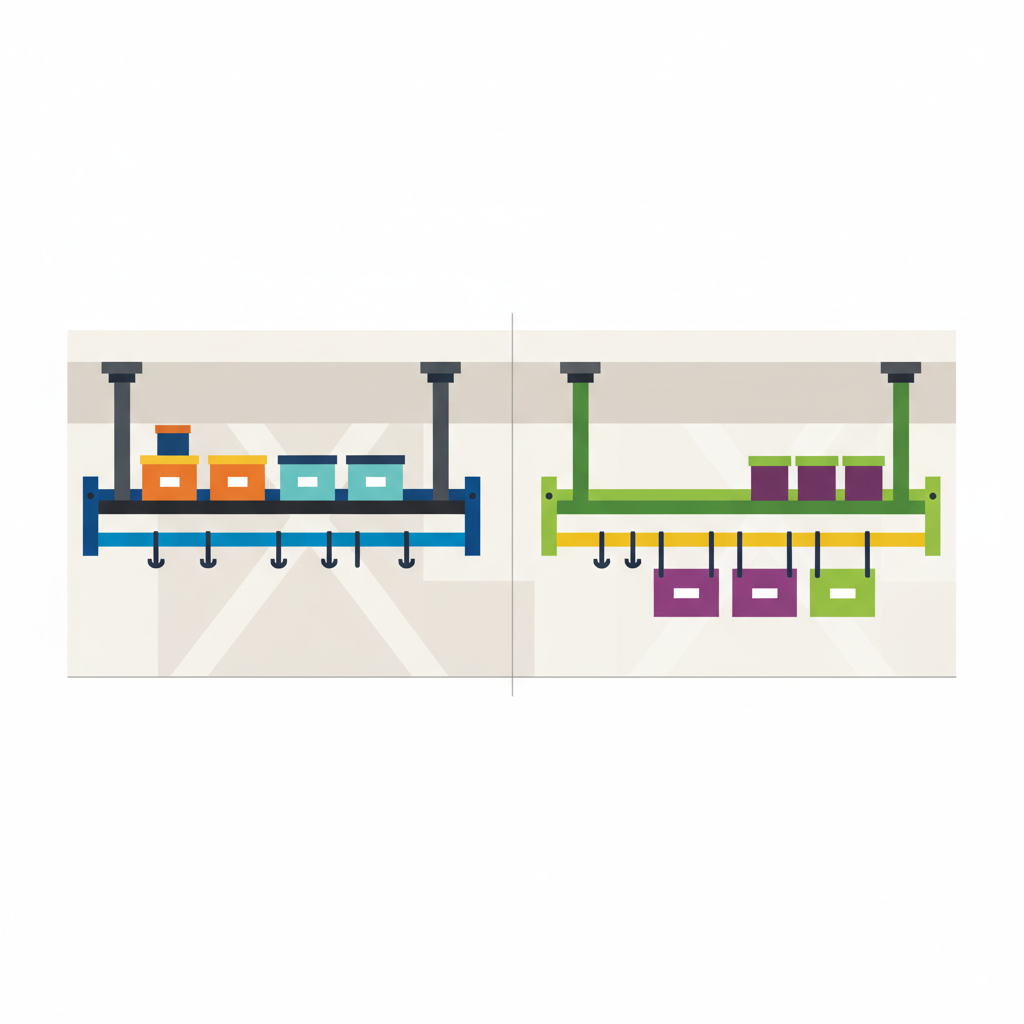
Introduction to Overhead Garage Storage
Overhead garage storage moves seldom-used items off the floor so you can actually park, walk, and work. For many households, that means bins of holiday décor, camping gear, and bulky sports equipment living above head height instead of crowding corners. If you’re weighing fixed racks as part of a SafeRacks Monkey Bars comparison, it helps to understand how ceiling systems are designed and what truly affects safety and longevity.
Prioritize structure. Look for powder‑coated steel, cross‑braced frames, and heavy‑duty hardware rated for wood joists or trusses. Verify the published load rating and the assumptions behind it (evenly distributed load, correct fasteners, and proper joist engagement). Adjustable drop ranges matter too—measure your ceiling height, garage door travel, and the tallest totes you plan to store.
Plan access. Ladders work for many, but lift‑assisted platforms and dedicated bicycle hoists reduce risk if you want to avoid climbing. Ceiling‑mounted elevators and simple pulley systems can bring storage down to you, keeping floor space clear without complicated motorized setups.
Fit the rack to real items and clearances:
- Common rack footprints (4×8, 3×6) fit above the hood of a parked vehicle or along sidewalls.
- A standard 27–32 gallon tote is roughly 13–16 inches tall; leave 2–3 inches of margin under the rack and below obstructions.
- Ten packed totes can approach 400–600 lb; choose a rating with headroom and never exceed it.
Durability shows up in the details: decking style (wire grid vs. mesh), weld quality, finish uniformity, and the rigidity you feel once the rack is fully fastened into multiple joists. Also consider warranty terms, available accessories (hooks for ladders or strollers), and installation complexity—single‑person friendly brackets can save time.
With that foundation, comparing overhead storage systems becomes clearer. Both leading brands offer durable storage racks that maximize garage space; the key differences often come down to bracket design, adjustability range, hardware quality, and how easily the system integrates into your broader home organization solutions.
SafeRacks Systems Overview
SafeRacks is a well-known name in garage ceiling storage, offering powder‑coated steel overhead platforms designed to maximize garage space without adding motors or complex mechanisms. The flagship 4x8 rack is commonly rated up to 600 lb when properly anchored into wood framing, with an adjustable drop range that typically spans roughly one to four feet to clear garage doors and tall vehicles. Wire‑grid decking improves visibility from below and allows sprinkler coverage where required.
For homeowners comparing options in a SafeRacks Monkey Bars comparison, the SafeRacks lineup stands out for straightforward, hard‑mounted construction. Upright posts attach to ceiling joists or trusses, a perimeter frame supports the wire deck, and most sizes include center bracing to reduce deflection under load. Installers can usually align posts to 16" or 24" on‑center framing; when joists run parallel to the platform, offset brackets or additional ledger material may be needed to hit solid wood. As with any overhead storage systems, the published capacity assumes even weight distribution—think bins spaced across the deck rather than a single point load.
Common sizes include 4x8, 3x8, 4x6, 2x8, and 2x6, which can be ganged in a grid for larger zones of durable storage racks. Accessory hooks expand function under the platform for ladders, folding chairs, or seasonal gear. For example, pairing a 4x8 with a set of deck and rail hooks can support 4–6 bicycles beneath the rack, freeing floor space while keeping handlebars out of vehicle paths.
Practical notes for home organization solutions:
- Verify door track and opener clearance at full raise.
- Use a stud finder to locate framing; avoid drywall‑only anchoring.
- Keep totes under the rated load and distribute weight across the frame.
- Consider powder‑coat color and ceiling height for a cohesive look and safe retrieval.
SafeRacks offers a broad, proven approach for homeowners seeking garage ceiling storage that’s configurable, durable, and built to maximize garage space without complicating access.
Monkey Bars Storage Solutions
Monkey Bars focuses on a dealer-installed, modular approach to garage ceiling storage. Their catalog typically includes overhead racks, wall shelves with integrated hanging bars, and bike hooks, designed to create a unified system rather than a one-off rack. For homeowners who want a cohesive plan and professional installation, this brand’s model can streamline decisions and deliver a tailored layout.
Build quality emphasizes powder‑coated steel components, heavy-duty fasteners, and joist-based mounting typical of overhead storage systems. Height-adjustable racks allow you to set clearance over vehicles and walkways, and under-shelf bars let you hang tools, lawn equipment, or sports gear beneath totes. When planned correctly, this layered approach helps maximize garage space without sprawling onto the floor.

Where Monkey Bars stands out:
- Dealer design and installation: A consultant measures your space, considers joist direction, openers, doors, and lights, and proposes a plan that balances load distribution and access.
- System integration: Wall shelving, hooks, and ceiling racks are configured together, reducing conflicts between components.
- Versatile zones: Seasonal bins up top; daily-use items on shelves and bars at reachable heights; bikes on dedicated hooks.
Considerations for a SafeRacks Monkey Bars comparison:
- Cost and access: Pricing is often higher and handled through local dealers, not big-box DIY channels. Lead times depend on dealer schedule.
- Flexibility: Custom layouts fit tricky ceilings well, but you’ll rely on the installer for changes later.
- Access method: Like most durable storage racks, standard Monkey Bars overhead options require a step stool or ladder for totes. If you prefer lift-assist or elevator-style access to avoid ladders, look beyond traditional racks.
- Verification: Weight ratings vary by model and mounting; confirm capacities, joist requirements, and clearances for vehicles and doors.
For quality-focused homeowners seeking durable, integrated home organization solutions with professional planning, Monkey Bars delivers a robust path to maximize garage space through coordinated overhead and wall storage.
Material Quality and Durability Comparison
When it comes to a SafeRacks Monkey Bars comparison, material quality and build choices drive long-term performance more than any single spec. Both brands market heavy-duty steel overhead storage systems, but the details—steel thickness, finish, hardware, and frame geometry—determine how well a rack holds up under real-world loads.
Steel and frame design
- Look for heavy-gauge steel with a continuous perimeter frame and multiple crossmembers. This reduces deck flex when you stack totes.
- Wire-deck panels should seat securely within the frame and resist racking under uneven loads.
- Center supports and diagonal bracing help minimize sway, which matters in garages with vibration or frequent door movement.
Finish and corrosion resistance
- A uniform powder-coated finish protects against humidity and road-salt exposure common in garages. Check for complete coverage on welds, edges, and wire intersections.
- In coastal or high-humidity regions, finish quality can be the difference between a clean, durable storage rack and early surface rust.
Mounting hardware and installation quality
- Both brands rely on lag bolts into ceiling joists; published load ratings assume proper joist engagement and spacing. Verify joist layout before purchase.
- Multi-point ceiling brackets disperse load and resist rotation. Hardware should be high-grade and appropriately sized for your joists.
- Example: A 4x8 rack loaded with eight 27-gallon totes can approach several hundred pounds. With quality hardware and cross-bracing, deflection stays minimal; with lighter-gauge steel or sparse mounting points, you’ll see noticeable sag and sway.
Weight ratings and verification
- Ratings vary by model; many 4x8 garage ceiling storage racks are in the several-hundred-pound class when properly installed. Ask for test methods, deflection data at rated load, and any third-party validation rather than relying on headline numbers.
Warranty and serviceability
- Long warranties are a useful proxy for confidence in materials and coatings. Review what’s covered (steel, finish, hardware) and whether DIY or dealer installation affects coverage.
For homeowners seeking durable storage racks to maximize garage space without complicated motors, prioritize heavy-gauge steel, robust powder coating, multi-point mounting, and clear, installation-backed load ratings—regardless of brand. These fundamentals yield safer, longer-lasting home organization solutions.
Installation Process and Complexity
In this SafeRacks Monkey Bars comparison, installation is where the two approaches diverge most clearly. SafeRacks is designed for confident DIYers, while Monkey Bars is typically a dealer-installed, turnkey solution.
SafeRacks arrives as a kit with pre-drilled components and labeled hardware. Most homeowners with basic tools can complete a 4x8 install in an afternoon. The process centers on finding ceiling joists, laying out clearances (garage door tracks, openers, lights, and attic access), and lag-bolting the ceiling brackets into the framing. Vertical posts and wire decks assemble quickly once the anchors are set and leveled. Expect to work from two ladders.
What a SafeRacks DIY install generally requires:

- Skill level: Moderate DIY (measure, drill, level)
- Tools: Stud finder, drill/driver, socket set, tape measure, level, impact-rated lag sockets, safety glasses
- Time/manpower: 2 people; 2–4 hours per rack, depending on ceiling height and obstacles
- Common pitfalls: Missing joists behind drywall, mounting into truss webs rather than chords, insufficient edge clearance for totes
Monkey Bars overhead storage is most often sold and installed through authorized dealers. The process starts with an on-site assessment to map your joists, note obstructions, and plan rack sizes and drops. Crews bring the hardware, set proper blocking if needed, and handle alignment across irregular joist spacing or vaulted ceilings. Install time is typically faster per rack because the complexity shifts to the pros, but scheduling and lead time can be longer than a DIY weekend project.
When a pro install is advantageous:
- Finished ceilings or irregular joist spacing (16/24/19.2 inches)
- Low headroom near garage door rails
- Mixed substrates (wood framing plus steel or concrete)
- Larger, integrated layouts spanning multiple bays
Bottom line: If you’re comfortable anchoring into structure and want a straightforward DIY path, SafeRacks fits well. If you prefer a done-for-you experience—especially in tricky spaces—Monkey Bars’ dealer install streamlines the process. Either way, correct fastening into framing is critical for durable storage racks that maximize garage space and support long-term home organization solutions.
Weight Capacity and Safety Features
In any SafeRacks Monkey Bars comparison, start with the manufacturer’s published load ratings—and what they actually mean in a real garage. Both brands publish capacity as an “evenly distributed” load, assuming proper installation into solid wood joists or truss chords. Exceeding that, clustering weight in one corner, or missing framing with fasteners will drastically reduce safety.
SafeRacks’ popular 4x8 rack formats are commonly listed in the 500–600 lb class when anchored to multiple joists. Their powder‑coated steel frames, full wire‑grid decking, and multi‑point ceiling brackets help spread load across a wider footprint. A perimeter safety lip and center support brackets reduce deck flex and keep bins from shifting, while adjustable down‑rods let you set a safe drop height above garage doors and vehicles.
Monkey Bars overhead storage is often dealer‑installed and configured to the space, which can improve how the load is distributed over joists. Systems typically use heavy‑gauge steel, triangulated bracing, and integrated lips on the platform to resist sway and slippage. Published capacities vary by model and configuration; many offerings target the same 600‑lb class, with some premium setups marketed higher when spanned across additional framing and installed by a pro.
Safety features and practices to prioritize:
- Large, multi‑joist brackets: Wider mounting plates and four‑corner suspension reduce point loads on a single joist.
- Redundant bracing: Cross‑members or center supports that limit racking and bounce when loading.
- Hardware quality: Grade‑marked lag screws/bolts sized for your joist depth; avoid generic drywall anchors.
- Deck design: Rigid wire‑grid or solid panels that won’t deform under totes; a 1–2 inch safety lip helps retain bins.
- Adjustability and clearance: Confirm drop height, garage‑door travel, lighting, and opener rails before installation.
Always verify your ceiling structure (joist spacing 16 or 24 inches on center, truss type, and span) and the cumulative load you plan to store. For heavy seasonal bins, tools, or camping gear, choose an overhead storage system with a conservative capacity, strong cross‑bracing, and wide mounting brackets. That approach yields durable storage racks that maximize garage space while preserving day‑to‑day safety within your home organization solutions.
Cost-Effectiveness and Value
In a SafeRacks Monkey Bars comparison, cost-effectiveness comes down to total lifetime value, not just the sticker price. Look at materials, load rating, installation method, adjustability, and warranty support. These details determine how well an overhead storage system performs year after year—and how safely it helps you maximize garage space.
Pricing models differ. SafeRacks is widely available as a DIY purchase, often delivering strong value per dollar for common sizes like 4×8. In many markets, a 4×8 rack with typical drop length falls in the mid-$200s to mid-$300s, with periodic promotions on accessories. Monkey Bars offerings are frequently sold and installed through dealers. That professional service can include design, ceiling assessment, and installation, which raises upfront cost; homeowners often report installed pricing per 4×8 unit ranging from the mid-hundreds into the low thousands, depending on market, ceiling height, and configuration. Quotes vary, but the trade-off is turnkey execution.
Beyond sticker price, compare features that affect long-term value:
- Load rating vs. your real needs (bins, tools, seasonal gear).
- Drop range adjustability to clear garage doors, open SUVs, and lighting.
- Powder-coated, corrosion-resistant steel and hardware quality.
- Mounting flexibility across joist directions and spans for safer anchoring.
- Fasteners rated for ceiling applications and clear install guidance.
- Warranty length and ease of claims; local service availability.
- Expandability with add-on hooks for bicycles or long items.
A simple cost-per-capacity lens helps. A 4×8 rack with an 18-inch drop provides about 48 cubic feet. At $300 DIY, that’s roughly $6.25 per cubic foot. At $900 installed, it’s about $18.75 per cubic foot—but includes labor, layout, and liability handled by a pro. For many quality-focused homeowners, that trade may be worth it.
Factor in ownership costs: time on ladders, the risk of overloading, and future reconfiguration. If frequent access is a pain point, pairing durable storage racks with lift-assist or elevator-style garage ceiling storage can improve safety and long-term value in your home organization solutions.

Making Your Storage Decision
Start with the basics of fit and structure. In any SafeRacks Monkey Bars comparison, confirm your ceiling joist spacing (typically 16 or 24 inches on center), ceiling height, and obstacles like openers, lights, or sprinklers. Measure the clearance above your fully opened garage door—many homeowners target a 12–18 inch buffer to safely slide totes on and off. If you have a finished drywall ceiling, plan for stud-finding and lag-bolt anchoring; exposed joists are simpler but still require fastening into solid wood, not just subfloor.
Match the rack to what you store. Both brands offer powder‑coated steel, wire‑deck platforms designed for totes, camping gear, and seasonal decor. If you store small items, add bins so they don’t slip through the wire grid. Tires or long items may need accessory hooks. For infrequent, heavy storage, a fixed overhead rack maximizes garage ceiling storage; for weekly access, consider a solution that brings the load down to you.
Evaluate adjustability and load ratings. Check each model’s height range to ensure you can drop the deck low enough for easy access but high enough to clear SUVs and garage doors. Verify the published load rating for your specific size and the required fasteners (look for substantial lag bolts and cross‑bracing). A conservative approach is best: spread weight across multiple joists and keep heavy bins to the perimeter above wall lines.
Consider installation and long‑term durability. Pre‑drilled rails, robust diagonal bracing, and corrosion‑resistant hardware speed installs and reduce sway. Look at warranty terms and availability of replacement parts. If your garage has 10‑foot ceilings and you routinely access 8–12 storage totes, a ceiling storage elevator can eliminate ladders entirely. If you bike regularly, a dedicated bicycle storage solution frees floor space and keeps handlebars out of car doors.
Quick checklist:
- Joist layout, ceiling height, and door clearance
- Weight per bin and total load distribution
- Frequency of access (fixed rack vs elevator)
- Hardware quality, bracing, and adjustability
- Warranty, parts support, and American‑made options
Choosing overhead storage systems with these criteria will maximize garage space and deliver durable storage racks that fit how you live.
Final Thoughts on Garage Organization
In a SafeRacks Monkey Bars comparison, the better choice comes down to your structure, load, and access needs—not just brand names. Both offer sturdy overhead storage systems, but the safest, most durable storage racks are the ones matched to your joists, your ceiling height, and how often you need to reach the items you’re storing.
Use this quick decision checklist:
- Structure: Verify joist direction, spacing, and load capacity. Plan to anchor directly into framing, not drywall or furring.
- Clearance: Measure door tracks, openers, lights, ducts, and cars with garage doors fully open. Confirm rack height adjustability fits.
- Load type: Store dense items (tools, hardware, books) near joist intersections and distribute totes evenly. Keep liquids and paint in climate-appropriate zones.
- Access frequency: Seasonal bins belong up high; weekly-use items should live lower or near the edge of platforms for safer reach.
- Installation and support: Favor brands with clear load ratings, grade-8 or equivalent hardware, and responsive warranty support.
Examples that work well:
- Seasonal: 6–10 clear totes of holiday décor on a 4x8 platform, labeled on both sides for quick retrieval.
- Outdoors: Camping bins and coolers overhead; sleeping bags in breathable bags to prevent compression.
- Sports: Bats, balls, and pads in front-edge bins; bicycles on dedicated ceiling or wall solutions to free floor space.
Safety and maintenance matter more than the logo:
- Don’t exceed rated loads; weigh a sample tote and multiply.
- Inspect fasteners annually; retorque as needed.
- Keep 18 inches of clearance from sprinklers where required by code.
- Avoid storing fuel or solvents overhead.
If ladders are the pain point, consider ceiling storage elevators for controlled, ground-level access. Pair a hard-mounted platform for long-term storage with a lift for high-use items to maximize garage space. For quality-focused homeowners who want American-made, long-lasting home organization solutions, Ceiling Sam offers garage ceiling storage options designed to simplify access and extend usable floor space without overcomplicating your setup.
Call to Action
Ready to get organized? Explore our American-made storage solutions and see what fits your garage best.
Questions about your garage? Real people, fast answers.
Call or text(480) 720-0593