

Motorized Overhead Garage Storage vs. Simple Ceiling Storage Elevators
Key Takeaways
Most motorized overhead garage storage systems introduce complexity through integrated motors, apps, and wiring that can fail in harsh garage environments, while a simple drill-powered ceiling storage elevator operates with far fewer components that could break down.
Electric motors, smart apps, wall remotes, and integrated electronics are vulnerable to dust, humidity, temperature swings, and power outages—conditions that are common in garages across the U.S. and Canada.
A mechanically simple, drill-powered ceiling elevator delivers the same core benefit of raising storage to the ceiling without requiring an electrician, ongoing maintenance schedules, or software updates.
The core theme here is straightforward: fewer parts mean fewer repairs, which translates to more long-term reliability and peace of mind for homeowners.
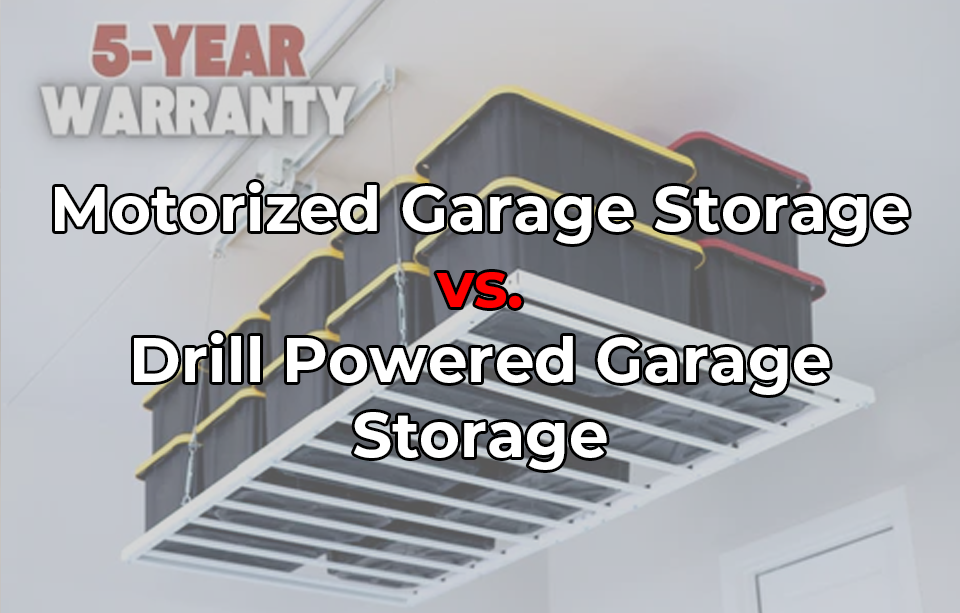
This article compares typical motorized systems (like 3’x4’, 4’x4’, and 4’x8’ lifts introduced in the early 2010s) with a modern, low-tech ceiling storage elevator to help you understand where each approach makes sense.
Non-motorized garage storage starts by moving bulky, seldom-used items off the floor and into the unused airspace overhead—so your car, workbench, and walkways stay clear and safe.
What Is Motorized Overhead Garage Storage?
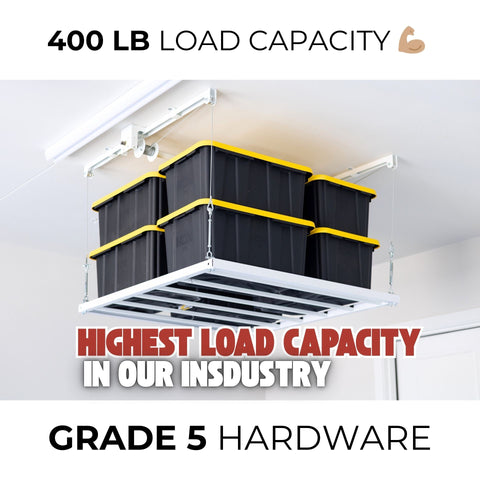
Motorized overhead garage storage refers to ceiling-mounted platforms that raise and lower using an electric motor—similar in concept to a garage door opener, but designed specifically for storage racks. These systems emerged as a solution for homeowners looking to reclaim valuable floor space by moving seldom-used belongings up to the ceiling.
Typical product formats include 3’ x 4’, 4’ x 4’, 3’ x 6’, 4’ x 6’, and 4’ x 8’ steel platforms. These have been commonly marketed as motorized garage storage lifts since around 2010-2015. The platforms are constructed from powder-coated steel frames with heavy duty decking and mounting brackets designed to attach to ceiling joists.
The main promise of these storage systems is push-button convenience. You can move totes, holiday decorations, sports gear, kayaks, paddle boards, and seasonal items between ceiling height and ground level without ever touching a ladder. This makes accessing heavy and bulky items significantly easier than traditional fixed overhead storage racks.
Common control options include:
Wall mounted control box with push buttons and keyed lockout to prevent unauthorized use
Wireless remote operating at 315–433 MHz frequencies
Newer models with Bluetooth or Wi-Fi app control
These systems typically include electric hoists, steel cables or webbing straps, real netting on all four sides for safety, and ceiling brackets that attach perpendicular to joists—much like a standard garage door opener installation.
How Motorized Garage Storage Lifts Typically Work
The core components of a motorized overhead lift include an electric motor (often 120V AC in North America), a gearbox, a drum or spool, lift cables or seat-belt style webbing, and a controller tied to a wall switch or remote. The motor powers the system, winding and unwinding cables to move the platform up and down while maintaining platform stability throughout the travel.
Consider a concrete example: a 4’ x 8’ ceiling lift with a 400 lb rated capacity powered by a 0.5–1.0 hp motor. This system might be controlled by a key-lock switch on the wall and backed by a 1-year motor warranty with a limited lifetime warranty on the frame. The platform itself can store boxes, gear, tools, and seasonal belongings all the way up near the ceiling.
The user workflow is straightforward:
Press and hold a button on the wall or wireless remote
The motor winds or unwinds the straps
The platform travels up or down with smooth travel
Limit switches stop the platform at pre-set top and bottom positions
Safety features commonly found in these systems include safety netting on all four sides, corner posts, overload protection, keyed lockout for child safety, and in some systems, automatic stops if resistance is detected. These features help prevent unauthorized use and protect both people and belongings.
However, the complexity of these systems means more wiring, more electronics, more firmware or software, and more moving parts than a purely mechanical elevator. Each additional component represents another potential failure point.
Common Failure Points in Motorized Overhead Garage Storage
Garages are harsh environments. Temperatures can swing from below freezing in winter to over 100°F in summer. Humidity levels fluctuate dramatically, dust accumulates constantly, and vibration from vehicles adds stress to mounted equipment. These conditions accelerate wear on motors and electronics in ways that indoor appliances rarely experience.
Motors and Gearboxes
Electric motors can overheat during operation, their bearings wear out over time, and gearboxes can strip teeth when lifts are routinely loaded near their 300–400 lb rating. The stress of repeatedly raising and lowering heavy loads in temperature extremes takes a toll on mechanical components.
Many manufacturers only provide 1–3 year motor warranties—a signal that these are considered wear items rather than lifetime components. When a motor fails after the warranty period, you’re looking at replacement costs, service calls, and potentially days without access to your stored belongings.
Electronics, Apps, and Remotes
Wall switches, wireless remotes, and smartphone apps depend on circuit boards, relays, and connectivity that can fail due to dust infiltration, moisture damage, or simple obsolescence. Specific issues include:
Apps requiring iOS/Android updates that may not be supported indefinitely
Discontinued manufacturer support after a few years
Connectivity problems in detached garages or areas with low signal
Circuit boards corroding in humid climates
When an app crashes or a remote stops communicating, your storage becomes inaccessible until you troubleshoot or replace the electronics.
Wiring and Installation
Hard-wired systems require 120V lines, junction boxes, and sometimes a new dedicated circuit. All of these add more failure points: loose connections, tripped breakers, and corrosion in damp climates. Incorrect DIY wiring can also pose safety and code-compliance concerns.
Many homeowners discover that the installation process itself requires hiring an electrician, adding several hundred dollars to the total cost before the system even lifts its first load.
Power Dependence
During power outages—common in storm-prone states like Florida, Texas, and coastal regions—motorized lifts are often completely unusable without backup power or manual override. Your storage becomes inaccessible exactly when you might need it most: during emergencies when you need camping gear, flashlights, or emergency supplies.
Maintenance Requirements
Manufacturers frequently recommend periodic lubrication, cable inspection, tension checks, and occasional professional service to keep warranty coverage intact. This ongoing maintenance adds both time and cost to ownership that many homeowners don’t anticipate when making their purchase.
Why a Simple Ceiling Storage Elevator Has Fewer Things to Fail
The alternative to motorized complexity is a mechanically simple, drill-powered ceiling storage elevator. This approach still raises a platform to the ceiling but eliminates built-in motors, circuit boards, and apps entirely. The philosophy is simple: remove the parts that fail.
Mechanical Simplicity
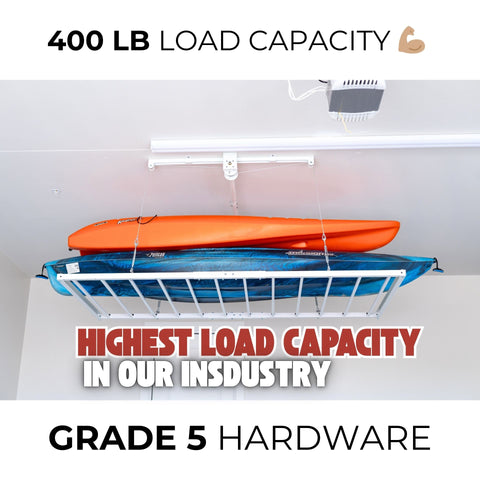
A drill-powered system is built around structural steel components, pulleys, and a mechanical drive that is powered externally by an ordinary handheld drill rather than a permanently installed motor. Fewer parts—no onboard motor, no internal electronics, no remote receiver—directly translate to fewer potential failure points.
The frame and mechanical components are typically made from the same heavy duty powder-coated steel as motorized alternatives, often in finishes like silver vein. The difference is what’s not there: no control boards, no firmware, no receivers that can fail.
Drill-Powered Reliability
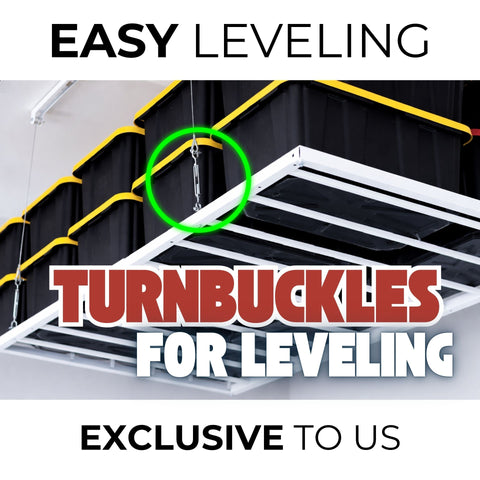
Any standard 18V or 20V cordless drill from brands like DeWalt, Milwaukee, or Makita can raise or lower the platform using a simple hex or socket interface. The homeowner uses a tool they already own and maintain for other projects.
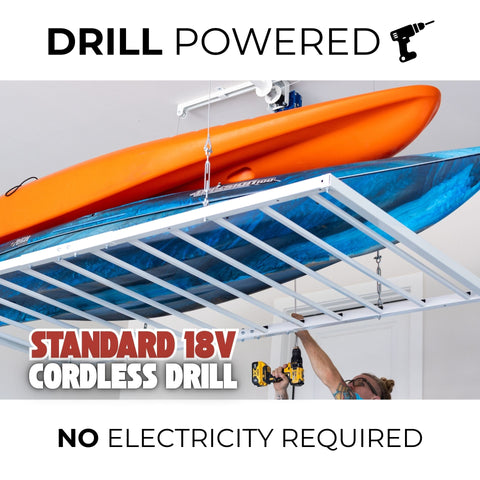
If your drill ever fails, it’s easily replaced or upgraded at any hardware store. You’re not dependent on proprietary lift motors, specialized parts, or manufacturer-specific replacements. The drill you use to build shelves, assemble furniture, and handle home projects becomes the same tool that operates your ceiling storage.
No Apps, No Firmware, No Crashes
A drill-powered system avoids smartphone integration by design:
No Bluetooth pairing required
No Wi-Fi dependence
No forced software updates
No app crashes
This makes the system future-proof against operating system changes and discontinued app support. You won’t find yourself unable to access your belongings because a manufacturer stopped supporting their app or because an update broke compatibility.
Independent of Grid Power at the Lift
Since the lifting power comes from a battery-powered drill, the elevator can still be used during power outages as long as the drill batteries are charged. While fully motorized systems often become inoperable during storms or outages, a drill-powered elevator remains accessible.
This resilience advantage is particularly valuable for homeowners who store emergency supplies, camping gear, or seasonal tools overhead.
Minimal Maintenance
With no integrated motor or electronics, the primary maintenance tasks are simple visual inspections of bolts, cables or straps, and pulleys a few times per year. In many cases, there’s no need for annual service calls, specialized technicians, or motor replacement after a decade.
The system you install is essentially the system you’ll have for years—without the creeping degradation that affects electronic components in garage environments.
Motorized Overhead Lifts vs. Drill-Powered Ceiling Elevators: Side-by-Side Comparison
Understanding the trade-offs between motorized and drill-powered systems helps homeowners make informed decisions. Here’s how the two approaches compare across key factors:
Operation & Convenience
|
Factor |
Motorized Overhead Lift |
Drill-Powered Elevator |
|
Control Method |
Push-button (wall or remote) |
Trigger-controlled drill |
|
Speed Control |
Fixed or preset |
Variable via drill speed |
|
Tools Required |
None (built-in) |
Cordless drill (commonly owned) |
|
Learning Curve |
Minimal |
Minimal |
Both systems are easy to operate, but the drill-powered approach relies on a tool most homeowners already own. Drill speed effectively acts as variable speed control for smooth travel—slower starts and performance & capacity.
Both systems can be designed to handle similar capacities—typically 300–400 lb of evenly distributed load on a 4’ x 8’ platform. The capacity limiting factor in a drill-powered system is typically the structural hardware and ceiling framing, not the drill itself. Modern cordless drills produce substantial torque that exceeds what’s needed to raise loaded platforms.
Long-Term Ownership Costs
|
Cost Factor |
Motorized |
Drill-Powered |
|
Initial Hardware |
$$$ |
$$$ |
|
Motor Replacement |
Likely after 5-10 years |
N/A |
|
Service Visits |
Periodic |
Rarely needed |
|
Control Board Failures |
Possible |
N/A |
|
App Obsolescence |
Risk over time |
N/A |
|
Cable/Strap Replacement |
Occasional |
Occasional |
While initial hardware costs may be comparable, motorized systems can incur additional long-term costs that drill-powered elevators avoid entirely.
Frequently Asked Questions
Can a drill-powered ceiling storage elevator handle the same weight as a motorized lift?
When properly designed, a drill-powered system can be rated for similar loads—often in the 250–400 lb range—as many residential motorized platforms. The true limit is usually the structural design of the platform and the ceiling framing, not the drill itself. Modern cordless drills generate substantial torque that easily exceeds lifting requirements. Always follow the specific load rating and installation instructions provided by the manufacturer, and ensure your ceiling can support the intended weight.
What happens if my cordless drill battery dies while the platform is in the air?
Well-designed drill-powered elevators include mechanical brakes or self-locking mechanisms in the drive so the platform does not free-fall if the drill stops. If a battery dies mid-lift, the system should simply hold position safely. You can then swap in a charged battery or use another drill to continue the operation. For longer loading sessions, keeping at least one spare charged battery available is recommended practice.
Do I need a building permit or inspection to install an overhead garage storage elevator?
Requirements vary by city, county, and state or province. Some jurisdictions may require permits for structural attachments or for new electrical work. Drill-powered systems usually avoid new electrical circuits, which can simplify the permitting process. However, local codes may still govern anchoring to ceiling joists or trusses. Check with your local building department or a qualified contractor before beginning any installation to understand applicable dates listed for permit requirements.
Can I convert an existing motorized storage lift to be drill-powered?
Most commercial motorized systems are not designed to be retrofitted for drill operation. Modifying them could void warranties or compromise safety. Rather than attempting a conversion, homeowners interested in mechanical simplicity should look for a purpose-built drill-powered elevator system. Using hardware exactly as it was engineered and tested by the original manufacturer is essential for safe operation.
How often should I inspect or service an overhead storage system?
A visual inspection at least twice per year is recommended, checking bolts, brackets, cables or straps, and the condition of the platform itself. Motorized systems may come with specific maintenance schedules—such as lubrication intervals or professional inspections—that should be followed to maintain warranty coverage. For drill-powered elevators, routine visual checks and basic hardware tightening are usually sufficient, assuming the system is used within its rated capacity. Understanding your system’s cancellation policy for service contracts and recurring or deferred purchase options for replacement parts can help with long-term planning. Payment method flexibility from manufacturers can also make maintenance more manageable when parts eventually need replacement.
Questions about your garage? Real people, fast answers.
Call or text(480) 720-0593