

Affordable Ceiling Storage Racks: Maximize Your Garage Space with Durable, Made-in-USA Solutions
Key Takeaways
Most garages waste the ceiling — it sits empty while floor space fills up with bins, gear, and boxes that belong overhead. Mounting storage racks directly to ceiling joists puts that space to work, safely holding hundreds of pounds of seasonal items above vehicles and walkways. The result is a cleaner, more usable garage without major renovation.
The Ceiling Sam Bin Slide, Tote Slide, Tote Slide Pro, and 4' x 4' Heavy-Duty Pro are durable, high-capacity ceiling systems engineered for long-term use in residential garages.
All four systems are made in the USA with robust steel construction and hardware designed to safely hold heavy seasonal items, totes, and bins above vehicles and workspaces.
Each option offers a different balance of cost, capacity, and convenience, allowing homeowners to choose an affordable system that fits their specific needs and storage habits.
This article provides neutral, educational guidance on selecting the right ceiling rack configuration for real-world garages built from the early 1990s through the 2020s.
Why Affordable Ceiling Storage Racks Matter for Today's Garages
Garages built between 1990 and 2020 typically range from 400 to 800 square feet. Despite this size, most of that space gets claimed quickly—by vehicles, lawn equipment, tool storage, and the inevitable accumulation of seasonal bins. Wall space fills up with pegboards, shelving, and cabinets, leaving little room for additional storage. Ceiling space, by contrast, often goes completely unused.
Overhead storage racks mount to ceiling joists. This transforms what many consider "dead" space into organized storage for totes, holiday decorations, camping equipment, and off-season items that only need access a few times per year.
Homeowners across suburban areas—from Mesa, AZ to Phoenix to Gilbert and similar markets—increasingly seek overhead storage that delivers professional-level strength without the price of a full cabinet system. A well-chosen set of racks can replace or supplement bulky shelving, often freeing 20 to 60 square feet of floor space in a standard two-car garage. This reclaimed area makes parking easier, creates room for workstations, and brings order to spaces that otherwise feel cramped.
This is where many homeowners realize just how much usable space has been sitting unused directly above them.
What Makes a Ceiling Storage Rack "Affordable" Yet Reliable?
The term "affordable" extends beyond the lowest upfront price. True affordability accounts for longevity, load rating, and how efficiently the rack uses cubic space in the garage. A cheap rack that fails after two seasons—or worse, one that falls under load—carries hidden costs far beyond its sticker price.
Load capacity represents another critical factor. Quality systems like those discussed here typically support 300 to 600 lbs per rack, with honest weight ratings backed by actual testing. Marketing claims that sound impressive but lack real-world verification can lead to dangerous situations—particularly when several hundred pounds hang above parked vehicles and family members walking through the garage.
Space efficiency determines how much value each rack delivers per dollar spent. Consider a 4' x 4' overhead storage rack: that 16-square-foot platform effectively "gives back" the floor area directly beneath it. In a typical two-car garage where every square foot matters, this reclamation makes a measurable difference. A family in a 2010-built three-car garage might store 12 to 16 totes overhead, keeping seasonal gear organized while maintaining clear floor paths.
Installation complexity affects overall affordability too. Straightforward mounting to ceiling joists or engineered trusses, combined with clear instructions and standard hardware, keeps labor costs manageable for a DIY-capable homeowner. A rack that requires specialized tools or professional installation erodes much of its cost advantage.
Most people underestimate how much the install process matters — a system that goes up cleanly without extra trips to the hardware store is worth a lot in practice.
Made in the USA: Why Manufacturing Quality Matters
All four systems examined here—Ceiling Sam Bin Slide, Tote Slide, Tote Slide Pro, and 4' x 4' Heavy-Duty Pro—are manufactured in the USA. This domestic production supports consistent quality control and ready access to replacement parts should components ever need service.
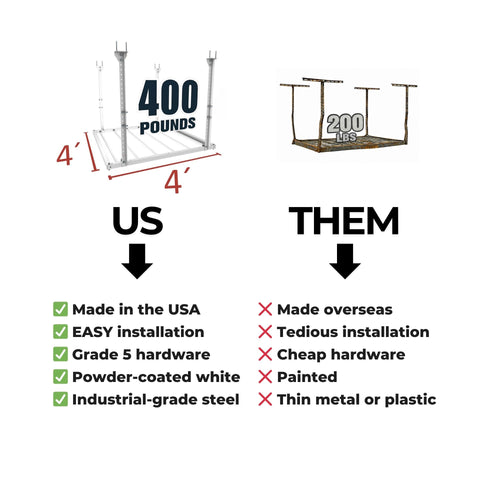
American manufacturing offers specific advantages for ceiling storage products. Tighter tolerances on rails and brackets mean components fit together precisely, reducing installation headaches and ensuring smooth operation. Reliable steel sourcing from domestic suppliers provides material consistency that affects both strength and finish quality.
Domestic manufacturing also leads to more honest load ratings. Products are designed and tested according to North American construction norms—specifically, typical 16-inch or 24-inch on-center joist spacing found in homes built from the mid-1980s onward. When a USA-made rack claims a 600-pound capacity, that number reflects testing against the actual framing conditions found in American garages.
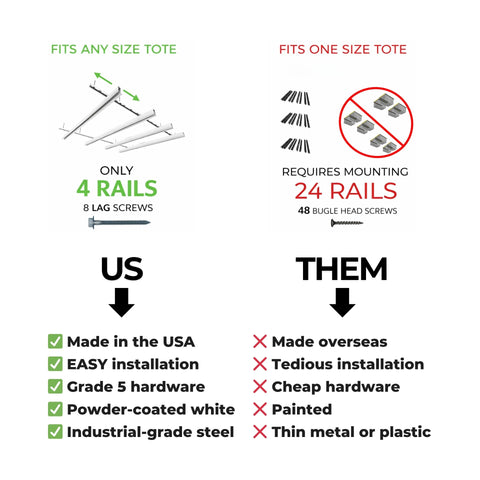
Hardware quality matters significantly when a rack holds several hundred pounds above parked vehicles, tools, and walkways. USA-made systems often include higher-grade fasteners—lag screws, washers, and mounting brackets engineered to maintain their grip over years of temperature cycling, humidity changes, and static load.
American steel construction, corrosion-resistant powder-coated finishes, and heavy-gauge hardware contribute to long service life and safety. Products manufactured in USA facilities often use steel with tensile strengths exceeding 50,000 psi, with weld integrity verified through quality control processes that overseas manufacturers may skip.
Homeowners who've installed imported racks often discover the difference in fit and finish after the first season — USA manufacturing shows in the details.
Ceiling Sam Bin Slide: Efficient Storage for Bins and Sam's-Style Containers
The Ceiling Sam Bin Slide is a fixed ceiling storage rail system designed for large warehouse-club bins like those sold at Sam's Club, Costco, and similar retailers. The product name reflects this direct compatibility. Rails mount overhead, and large rectangular bins slide horizontally along the tracks for easy retrieval from below.
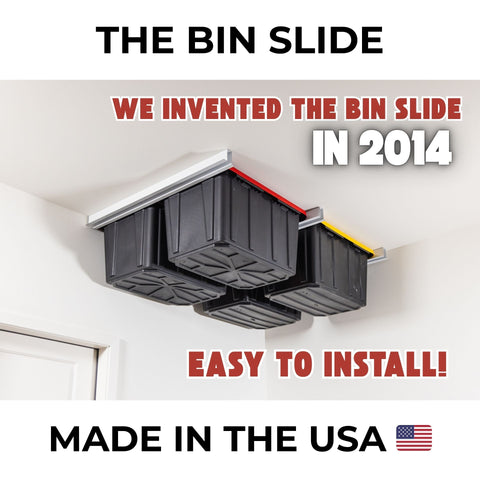
The primary use case centers on slide-out access from below. Rather than climbing a ladder and lifting bins down from a static platform, users can reach up and slide a specific bin out along the rail, retrieve what they need, and push it back into position. This approach saves time and reduces the physical strain of overhead work.
Capacity specifications indicate that multiple rails can support several bins per bay. When mounted into joists according to manufacturer instructions, the system handles substantial weight through even load distribution—a key engineering principle that spreads stress across multiple structural members rather than concentrating it on a single point.
The rails and brackets use USA-made steel designed to resist flex and sag when loaded. Hardware suits typical 2x6 or 2x8 ceiling framing found in garages from the 1990s through recent construction. Corrosion-resistant finishes protect against the humid conditions common in many garage environments, where imported alternatives may corrode two to three times faster.
From an affordability perspective, a row of Ceiling Sam Bin Slide rails along a 16–20 ft garage bay can replace an entire run of wall storage shelving at comparable or lower cost, while freeing that wall space for tools, bikes, or other vertical storage options.
Once the rails are up and loaded, most people are surprised by how much bin access they get without ever needing a step stool.
Tote Slide: Simple, Cost-Effective Overhead Tote Storage
Tote Slide offers a streamlined ceiling rack that holds common storage totes between steel rails. This system works particularly well for households that already own mixed-size plastic totes and want to relocate them overhead without purchasing specialized containers.
The rails mount directly to ceiling joists, creating parallel channels where the lips of plastic totes rest securely. Tote bottoms face down toward the garage floor, keeping contents visible if using clear or labeled containers. This orientation also allows dust and debris to fall away rather than accumulating inside storage bins.
In practical terms, a properly installed run of Tote Slide rails safely holds multiple full totes of holiday decorations, camping gear, or sports equipment. The system supports approximately 300 pounds distributed across four to six standard totes (roughly 18x16x12 inches each), assuming users respect both per-tote weight limits and the overall system capacity.
Rail spacing accommodates common tote widths without requiring custom fitting. Standard hardware-store totes from Rubbermaid, Sterilite, or comparable brands generally fit within the specified rail dimensions. This compatibility reduces the need to purchase proprietary containers and allows the system to work with bins already on hand.
Installation requires ceiling joists at standard spacing, a drill, lag screws, and a level. Most homeowners complete a single-bay installation in one to two hours, making this a weekend project rather than a multi-day renovation. Spacing between rails adjusts to fit joists at 16 or 24 inches on center.
Sizing considerations include available ceiling height. The system works well in garages with 8 to 10-foot ceilings, where headroom remains adequate both for loading totes and for clearance of vehicles with higher rooflines. Verify clearance measurements before purchasing by checking the tallest vehicle that regularly parks in the space.
Placement options include runs along garage sides, above door openers and rails where clearance allows, alongside existing openers, or in corners where wall cabinets would interfere with vehicles, lawn equipment, or walkways.
Everyday benefits include the ability to slide individual totes out for a season—winter sports gear from November to March, for example—then swap them with off-season bins. This creates a rotating overhead "storage calendar" that keeps frequently needed items accessible while maximizing space for long-term storage.
Most garages need more ceiling clearance than people expect, so always check your tallest vehicle before deciding on rack height.
Tote Slide Pro: Higher Capacity and Flexibility for Heavy-Duty Needs
Tote Slide Pro builds on the basic Tote Slide concept with thicker-gauge steel, enhanced brackets, and higher weight capacity per position. This upgraded system addresses the needs of homeowners who store heavier items overhead and require additional safety margin.
The capacity upgrade centers on engineering for denser loads. Where basic overhead racks might struggle with totes full of tools, hardware, or archived files, Tote Slide Pro handles approximately 400 pounds via dual reinforced rails and locking pins. This expanded capability means homeowners can store substantial collections without worrying about exceeding system limits.
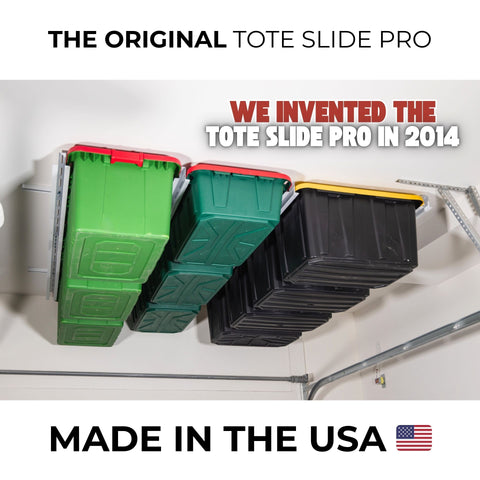
Construction quality reflects USA manufacturing standards. The steel rails feature additional bracing or cross-members, and high-grade fasteners anchor into multiple joists to spread loads over a wider area of ceiling structure. Products adhere to ASTM standards for load testing, providing confidence that published ratings reflect real-world performance.
The ideal user profile includes homeowners with larger three-car garages or workshops where heavier seasonal storage—including tool collections, archive boxes, and equipment not used year-round—accumulates over time. The Pro version provides appropriate margin for this use case without requiring a custom or commercial-grade system.
Compatibility with standard tote sizes remains consistent with the base Tote Slide. The Pro version uses wider or reinforced channels that accept the same bins. This backward compatibility means homeowners who start with a basic system can upgrade sections to Pro capacity without replacing all their totes or starting over with new containers.
When storage requirements grow over time, the Pro system gives you room to add weight without rethinking the whole setup.
4' x 4' Heavy-Duty Pro: Compact, High-Capacity Ceiling Platform
The 4' x 4' Heavy-Duty Pro takes a different approach from rail-and-tote systems. Instead of sliding bins along tracks, this unit provides a solid platform mounted directly below ceiling joists. The platform surface features a grid or wire design intended to keep boxes and totes from tipping or shifting. Waterfall edges contain items during movement or minor vibrations from nearby workshop activity.
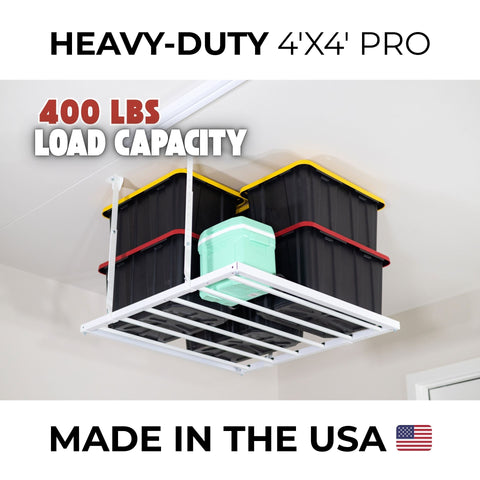
Capacity specifications indicate that a properly installed 4' x 4' platform holds up to 600 pounds when lag-bolted into multiple joists. This often translates to six to ten medium storage totes or multiple large boxes, providing substantial overhead storage in a compact footprint.
Ideal placements include areas above garage door rails where clearance allows, alongside existing openers, or in corners where wall cabinets would interfere with vehicles, lawn equipment, or walkways. The adjustable height feature—ranging from 18 to 42 inches below the ceiling—accommodates different garage configurations and vehicle heights.
At approximately $149.99 for the rack, a single 4' x 4' Heavy-Duty Pro instantly adds 16 square feet of overhead storage. Multiple units arranged in a grid suit different garage sizes without requiring custom fabrication, keeping costs predictable and installation straightforward.
This platform-style rack complements track-based products like the Bin Slide or Tote Slide systems. Homeowners can create a mixed configuration: platform storage for bulky items like luggage or sporting equipment, combined with sliding tote storage for seasonally rotated bins. This flexibility lets each storage area serve its most appropriate function.
Fixed platform racks like this one tend to be the most reliable long-term option — fewer moving parts means less to maintain or adjust over the years.
When comparing fixed or hard-mounted ceiling storage to motorized or chain-hung lifting systems, the differences come down to reliability, maintenance, and how you use the space over time. Fixed racks have no mechanical components to service or replace, which means they perform the same on day one as they do five years later. Motorized systems offer convenience for heavy or awkward loads, but motors and drive mechanisms can wear out, require lubrication, or need replacement — adding long-term costs that fixed systems avoid. For most homeowners storing seasonal bins and equipment accessed a few times per year, a fixed rack installed once and loaded carefully will outlast and outperform more complex systems. Chain-hung platforms can also shift or sway under load, which concerns some homeowners storing items above vehicles.
Selecting the Right Combination for Your Garage Layout
System selection depends on three factors: ceiling height, joist spacing, and the types of items being stored. Begin with a thorough measurement of the available overhead space and identify joist locations using a stud finder.
For a single-car garage with standard 8-foot ceilings, a single run of Tote Slide or two to three Bin Slide rails generally provides adequate overhead storage without compromising vehicle access. This configuration typically handles 8 to 12 standard totes—enough for most single-family storage needs.
Two-car garages support more variation. A practical layout pairs one run of Tote Slide Pro along one side—handling heavier seasonal storage—with Bin Slide rails in the center for uniformly sized warehouse bins. This zone approach separates heavy from light storage without overloading any single joist bay.
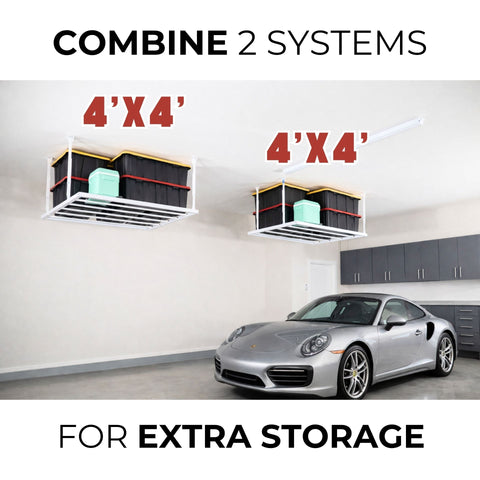
Three-car or tandem garages offer more options. Consider pairing Tote Slide Pro along deeper bays (where heavier items may need storage) with several Ceiling Sam Bin Slide rails in the central bay for uniformly sized warehouse-club bins. This arrangement creates zones: heavy-duty storage where needed, convenient slide-out access for frequently rotated items.
Weight distribution deserves careful thought. Spread heavy items—tools, archived files, dense equipment—across multiple joists. Reserve the lightest items for spans that cross garage doors or openers, where structural constraints may limit capacity. This approach prevents overloading any single area while maximizing total storage potential.
Taking the time to map out your layout before ordering saves a lot of frustration — knowing where each joist falls makes placement decisions much easier on install day.
Clearance measurements prove essential before finalizing any layout. A well-planned overhead storage system is one you stop thinking about — it just works, season after season, keeping the garage clear and the gear where you can find it.
Questions about your garage? Real people, fast answers.
Call or text(480) 720-0593